
The Last Ox-Ploughing in Chungju: A Microhistory of a Gowun-ri Farm and the Co-evolution of Terrain and Technique
Abstract
This study reframes ox-ploughing in Gowun-ri (Suanbo, Chungju) as a living technique, integrating microhistory, oral history, and a technocultural lens on human–animal–tool cooperation under geomorphic and edaphic constraints. In a mosaic of steep transitions, stoniness, shallow soils, and narrow access, ox-ploughing manages risk through rhythmic coordination—gait sync, share pitch/roll, and prosodic commands. Event-based analysis shows that in elongated plots buffer strips and U-turn re-entry improve safety and productivity, while reverse scheduling tied to markets, licensed transport, and veterinary windows reshapes the calendar. Persistence is modeled as a threshold coupling of environment (mosaic), skill (stabilized rhythm), and infrastructure (logistics continuity). The approach operationalizes STS and multispecies anthropology at the event scale and advances a rhythm-based view of technique. Policy directions: micro-terrace/edge upkeep; improved access and turning space for mixed ox–machine work; continuity of licensed transport and veterinary services; heat/slip-index stop rules.
Keywords:
Ox-Ploughing, Technoculture, Microhistory And Oral History, Sloped Agriculture, Multispecies, STS, Chungju (Gowun-ri)1. Introduction
Ox-ploughing was for centuries a foundational technology of agriculture on the Korean peninsula. Since the rapid mechanization of the 1970s, however, ox-drawn tillage has entered a phase of near extinction as an everyday practice, and most contemporary records cast it as a folkloric reenactment for heritage villages and “experience” programs. The prevailing view is that ox-ploughing has exited as technology and survives only as culture.
Gowun-ri, Suanbo-myeon, Chungju, stands as a notable exception. Here the ox remains a primary laboring agent in core operations—ploughing, furrowing, bed making, and plastic mulching. Field records indicate that this persistence is not simply a matter of heritage preservation; it is tightly coupled to a set of geomorphic and edaphic constraints—steep slopes, stoniness, and shallow effective soil depth. Under conditions where two-wheel cultivators and tractors face poor access and sharply reduced work efficiency, ox-ploughing functions not as a vestige of the past but as a present, survival-oriented technique.
From a geomorphological standpoint, the Gowun-ri area is a mountainous terrain in which stoniness, effective soil depth, erosion, and slope are interlaced in a mosaic pattern. Slopes on upland fields around ~15° act as operative “signals” that govern task choice, movement paths, and tool handling. This coupled regime of “stone–slope–soil depth–erosion” weakens the efficiency of mechanization outside a few planar pockets near valley floors and, in turn, supplies an environmental rationality for the continued use of ox-ploughing.
The human–environment dimension reinforces this logic. Gowun-ri is an inland mountain village where mountain ridges, valley bottoms, and footslopes lie in close proximity. Portions of the valley floor are paddy fields, while footslopes and hillsides present a mixed land use of dry fields, orchards, and pasture. This mosaic land use fragments cultivation units, renders narrow and steep approach paths and stone obstacles a constant, and ultimately demands micro-mobility from the human–ox–tool ensemble.
Ox-ploughing is also bound up with shifts in labor organization and distribution networks. Communal ownership and shared labor (the eouri-so system and pumassi) have largely given way to individual ownership and solo work. The chain connecting cattle markets, itinerant traders, licensed transport, and livestock cooperatives has operated as an economic and logistical circuit that extends beyond the narrow frame of “technique.” Accordingly, the decline or persistence of ox-ploughing is not merely a question of obsolete versus preserved technology; it is inseparable from rural restructuring and the reconfiguration of labor and logistics.
This article systematically documents contemporary ox-ploughing in Gowun-ri and analyzes the conditions of its persistence or disappearance through the lens of environment–technology–society interactions. Methodologically, it (1) uses ethnography and oral history to reconstruct work rhythms, command language, and tool systems; (2) interprets the spatiality of work constraints—slope, stoniness, shallow soil, and erosion—using geomorphological and soil information; and (3) from a technocultural perspective, reconstructs the cooperative technique of humans, animals, and tools. In doing so, it positions ox-ploughing as a current field technique irreducible to “experiential tradition” and offers empirical and theoretical grounds for thinking about the sustainability of mountain agriculture.
2. Literature Review
2.1 History of Agricultural Technology in Korea: Ox-Ploughing and Collective Labor
Up through the late Joseon period, Korean agriculture relied centrally on ox-drawn tillage and plough technology; the gyeori system—two oxen yoked to a plough—was common, and labor was seasonally organized to match crop rotations (National Institute of Korean History, n.d.; National Institute of Korean Language, n.d.). At the village scale, the collective labor organization dure enabled coordinated work at peak moments such as transplanting and weeding; although it declined with modern land privatization, it persists in heritage form (Academy of Korean Studies, n.d.). Taken together, these technical and organizational arrangements show a historical configuration in which land use, crop regimes, and communal norms were articulated through ox-ploughing (Korean Society of Agricultural History, 2002–). (e.g., two-ox ploughing; mixed rotations in dryland–paddy systems).
2.2 Mechanization and State Policy
The 1978 Act on the Promotion of Agricultural Mechanization established an institutional framework for machinery development, dissemination, and after-service, accelerating mechanization (Korea Law Information Center, 2024; National Archives of Korea, n.d.). The spread of two-wheel cultivators, tractors, and rice transplanters from the 1960s to the 1980s reduced labor time and raised productivity; subsequent systems for safety management, testing, and insurance expanded the social infrastructure of mechanization (The Nongmin Newspaper, 2015, 2020; Nongsuchsansinmun, 2025; Korea Crop Insurance Corporation/Agri-Policy Finance, n.d.). This transition was not a mere swap of motive power but a systemic transformation entangled with land improvement, custom-hiring and rental markets, and codified safety norms.
2.3 Geomorphology–Soils and Mechanization Interactions
Field operations on slopes increase rollover risk—e.g., around a 12% slope, contour travel by standard four-wheel tractors can be hazardous—and constrain machinery selection and operating modes (FAO, n.d.; HSE, 2024; Vigoroso et al., 2019). High stoniness raises implement wear and power demand, depressing efficiency and elevating costs (FAO, 2006; Toscano et al., 2022; University of Wisconsin Extension, 2005). Korean data and engineering safety reports likewise identify slope, surface roughness, and travel speed as principal factors in machinery overturns (agricultural/biological systems engineering safety materials). Collectively, these studies indicate that the material regime of terrain and soils channels the pathways of technological adoption.
2.4 Livestock Distribution and Market Restructuring
Unlike the era when ox-power anchored farm traction, contemporary livestock and by-product distribution has been reorganized around standardized pathways for slaughterhouse hygiene, disease control, and logistics, with the traditional ox markets diminished or transformed. During outbreaks such as FMD, local markets saw repeated temporary closures; distribution shifted under regulation and monitoring (KREI, 2015; Kookmin Ilbo, 2010). These changes have had long-term effects on household cattle-keeping and trading practices and on the community culture of “market day.”
2.5 STS and Multispecies Perspectives on Human–Animal–Machine Relations
This study draws on Science and Technology Studies (STS) and multispecies anthropology. STS treats knowledge and technology as co-produced within socio-material networks involving human and non-human actors, analyzing the processes of translation that constitute such networks (Callon, 1984; Latour, 2005). Multispecies anthropology focuses on the entanglements of labor, care, and sensation among humans and other species (livestock, plants, microbes), critiquing anthropocentrism (Haraway, 2008; Kirksey & Helmreich, 2010). We mobilize these lenses at the event scale, proposing a rhythm-based account of cooperative technique. In this framing, ox-ploughing is an actor-network of human–ox–tool–terrain, where technology, environment, and living beings are mutually constitutive (Latour, 2005; Callon, 1984; Haraway, 2008; Kirksey & Helmreich, 2010; Ingold, 2000).
2.6 Microhistory and Oral History
A microhistorical approach—thickly documenting the technical and lifeworld histories of a single household and village to illuminate macro-level transitions (mechanization, distributional restructuring, rural social change)—has been widely justified since Ginzburg and Levi (Ginzburg, 1980/1982; Levi, 1991). Oral history extends evidentiary depth by bringing memory, meaning, and affect into textual form (Yow, 2015; Portelli, 1991). Adhering to informed consent, anonymity, and non-disclosure of primary media (research ethics), this study reconstructs the “last scenes” of ox-ploughing—and their subsequent transformations—through multilayered interviews that include family members, neighbors, and technicians (repair specialists).
3. Research Design
3.1 Objectives and Research Questions
The primary objective is to reconstruct, through microhistorical and ethnographic methods, the actually existing system of technique–labor–environment underpinning ox-ploughing in Gowun-ri, Suanbo-myeon, Chungju, and to explicate the interactions among geomorphic/soil constraints and the human–animal–tool ensemble from a technocultural perspective. Accordingly, this study asks: first, how physical conditions—slope, stoniness, and effective soil depth—structure cultivation units and task choices; second, how command language, tool configuration, and body angles operate as a coordinated rhythm; and third, how changes in distribution infrastructures (cattle markets, licensed transport, livestock cooperatives) articulate with the conditions of persistence. Taken together, these questions serve to re-locate ox-ploughing as a current field technique irreducible to “experiential tradition.”
3.2 Case Selection and Rationale
The case centers on a specific household in Gowun-ri and the set of small, sloping plots/orchard/pasture patches it actually cultivates. Selection rests on two considerations: (i) this is one of the rare sites where ox-ploughing remains in active use; and (ii) a mosaic of slope, stoniness, and shallow effective soil depth depresses the efficiency of powered machinery, conferring an environmental comparative advantage on animal traction. While the longitudinal record focuses on one household, observations of adjacent plots and supplementary interviews with neighboring farmers are incorporated.
3.3 Data Composition and Collection Procedures
The corpus consists primarily of the researcher’s field materials, with strict non-disclosure and non-redistribution of all primary data. Primary sources include recorded and transcribed oral histories, work logs and field notes, sketches of task order/tool setup/movement paths, and minimally framed photographs and video. Secondary materials are limited to national geomorphology/soil maps, basic statistics, historical maps, and aerial imagery of village land use, used solely to contextualize the primary corpus. Collection proceeds longitudinally across key seasonal operations—sowing, primary tillage, bed formation, soil preparation (seongji/jeongji), plastic mulching, and harvest—recording in each phase the command lexicon, bodily movements, implement angles, and soil responses at fine resolution.
3.4 Analytic Framework and Operational Definitions
Analysis is integrated under a co-evolutionary frame of terrain–technique–society. In the geomorphology/soils domain, we operationalize slope, stoniness, effective soil depth, surface stability, access-path width and curvature, and the distribution of terrace walls/boundary stones. Slope is expressed as relative slope derived from contours and described as level, moderate, or steep; stoniness is categorized as low/medium/high based on surface exposure and the frequency of implement contact during work. In the technocultural domain, we reconstruct the tool repertoire (e.g., share/plough body, koture, kotari, double-kotari, geukjaengi), the form/frequency/functions of commands, and the sequence/angles/pressure control of work movements as units of rhythm. In the social/logistical domain, we sequence the transformations of communal ox ownership (eouri-so) and mutual labor (pumassi), the shift to individual ownership, and the cattle market–licensed transport–livestock cooperative chain as a life-history event series. These subcomponents are cross-referenced to infer the environmental and social rationalities underpinning the persistence of ox-ploughing.
3.5 Qualitative Analytic Procedures
Transcripts are segmented into meaning units. Open coding elicits concepts such as “terrain signals,” “movement–implement adjustment,” “command functions,” “risk avoidance,” “task unit partitioning,” and “distribution pathways.” Axial coding then probes the causal linkages among “environmental constraint—technical adjustment—economic decision-making,” and selective coding identifies two core categories explaining persistence: micro-mobility in a mosaic environment and the stabilization of cooperative rhythm. In parallel, a time–motion analysis visualizes event-based sequences—e.g., “crossing a stony cluster,” “boundary-wall turn,” “abrupt slope transition”—tracking changes in commands, implement angles, and gait/stride. Where appropriate, member checking is used to validate terminology and interpretations with participants.
3.6 Spatial and Visual Analytic Procedures
Sketch maps per cultivation patch are combined with photo metadata to overlay slope transitions, stony concentrations, boundary stone lines, work paths, and turning radii. These overlays are reconciled with publicly available high-resolution DEMs and base soil maps, while coordinates are transformed/generalized to prevent identification of private property. Outputs privilege qualitative diagrams and schematics sufficient to narrate the spatial conditions under which ox-ploughing is favored, rather than reporting precise quantitative metrics.
3.7 Validity and Reliability Strategies
Triangulation across methods (interview–observation–sketch), sources (principal actor–family–neighbors), and time (repeated observation at seasonal phases) enhances interpretive stability. An audit trail documents the analytic process and version history. Negative case analysis—e.g., low-slope plots where ox-ploughing was nonetheless chosen, or high-slope plots where specific machinery substituted—tests and refines category boundaries. Researcher positionality (observer effects, expectancy) is made explicit, and local terms are stabilized through member checking.
3.8 Research Ethics and Data Governance
The study enforces a strict no-leakage policy for primary materials. All personal names, parcel identifiers, and precise locations are pseudonymized or generalized; photographs and video are edited to remove or pixelate identifiable persons, dwellings, and vehicles. Primary data are stored only on offline encrypted media; cloud uploads are prohibited. In-text citations use an anonymized code format—“Field Record [code]-YYYYMMDD-session”—restricted to summarized, indirect quotation. Interviews/observations are conducted on the basis of prior informed consent; consent forms are stored separately until project completion. Ethically sensitive content is constrained after fact-checking and harm assessment (IRB No. KKUIRB-202503-HR-050).
3.9 Limitations and Risk Management
As an in-depth single-village, single-household case, generalizability is limited to smallholder mountain agriculture under comparable terrain and cultivation conditions. The researcher’s long-term involvement may shape interpretation; member checking and negative case searching mitigate over-immersion. Weather/disaster events and animal health contingencies may preclude observation of particular phases; repeat observation in subsequent cycles or retrospective reconstruction from prior records is used as a fallback. Deliberate coordinate generalization may reduce cartographic precision but is treated as a necessary measure for privacy and property protection.
3.10 Outputs and Notation Rules
Final outputs comprise the main text and appendixed diagrams/schematics; the primary data themselves remain non-public. In-text references use anonymized field codes only (see Appendix A). Tables and figures are accompanied by captions and concise methodological notes sufficient for standalone reading. Maps/diagrams explicitly state coordinate transformation and scale generalization.
4. Study Area and Context
4.1 Geography and Landforms
The study area presents a composite terrain in which inland mountains and fluvial valley floors alternate over short distances. Pronounced slope breaks run from the footslopes into the valley bottoms, and ridge crests, hillslopes, and small valley pockets recur at tight intervals. Arable land therefore appears as small, fragmented patches. These geomorphic conditions subdivide cultivation units and impose structural limits on machinery turning radii and access. In practice, they preserve an environmental niche for animal traction, with boundary retaining walls/stone lines, minor steps along lower slopes, and abrupt slope transitions acting as operative signals for task selection.
4.2 Soils and Hydrology
Soils form a mosaic of zones with shallow effective depth and frequent surface gravel exposure interspersed with deeper, better-drained pockets. Summer rainfall brings a standing risk of surface-soil displacement, while dry seasons harden the surface and raise draft resistance. In gravel-rich zones, repeated contact between the share and stones induces vibration, prompting fine real-time adjustments in the human–ox–tool rhythm that momentarily alter share angle and depth. Hydrologically, transient inundation in the valley floor and rapid drainage on slopes force re-timing and resequencing of sowing, soil preparation, and bed formation.
4.3 Land Use and Patch Structure
Land use follows a fine-grained alternation of paddy, dry fields, orchards, and pasture, with parcel boundaries demarcated by stone walls or piles and boundary trees. Parcels are typically elongated, and access paths are narrow, constraining equipment ingress and turning. As a result, cultivation and harvest are executed in small chained units, and the adjustments in movement, command voice, and tool settings at transition points constitute the core of the farm-work rhythm. This spatial configuration depresses the efficiency of powered equipment but favors ox-drawn systems that can maneuver nimbly at small scale.
4.4 Climate, Agricultural Calendar, and Work Windows
Marked seasonality in insolation and precipitation creates clear seasonal work windows for the sequence of sowing, soil preparation, plastic mulching, weeding, and harvest. The monsoon heightens risks of topsoil loss and schedule delays, while heat accumulation increases human and animal thermal stress. Early morning and late afternoon are therefore preferred; slope shading and ventilation further shape daily time allocation. The practical viability of ox-ploughing is most evident where these climatic constraints converge with terrain and soil signals.
4.5 Local Community and Changing Distribution Channels
Earlier communal labor regimes and livestock trading routes have been reduced or reshaped by urbanization, regulation, and logistics standardization. Today, individual ownership of equipment and animals predominates, yet informal sharing of techniques and tools and exchanges of know-how persist at specific work phases. Animal movement, trade, and veterinary care follow formalized channels, and the associated costs, time, and distance constraints indirectly enter household calculations about the persistence of ox-ploughing.
4.6 Contextual Implications
Taken together, the terrain, soils, land use, climate, and socioeconomic setting argue that the persistence of ox-ploughing is not a matter of heritage conservation alone, but a realist choice under multi-factor constraints. In particular, the combination of small elongated patches, abrupt slope changes with stony segments, and narrow approaches demands micro-mobility from the human–animal–tool ensemble—demands that, in turn, drive skill formation and rhythmic coordination in ox-based fieldwork.
5. Findings
5.1 Organization of the Technical Repertoire and Work Rhythm
Ox-ploughing operates as an integrated rhythm linking a tool repertoire (share/mouldboard, koture, kotari, double kotari, geukjaengi), a prosodic command system (short, stress-marked utterances), and bodily regulation by the handler (angles, stride, hand pressure). The baseline sequence observed is entry → alignment → tillage → turn → re-entry; at each stage, human–ox stride synchronisation damps micro-vibrations (share roll/pitch) and minimises implement damage ([B-2024-06-22], [C-2024-07-03]). Near boundaries, strides shorten relative to normal, with repeated adoption of a lowered hip–shoulder angle—foundational to micro-mobility in response to terrain/soil signals. In Figure 1, Sg denotes the human–ox stride-synchrony index (0–1) and Ac the relative command-stress index. See Figure 1 for the triadic structure.
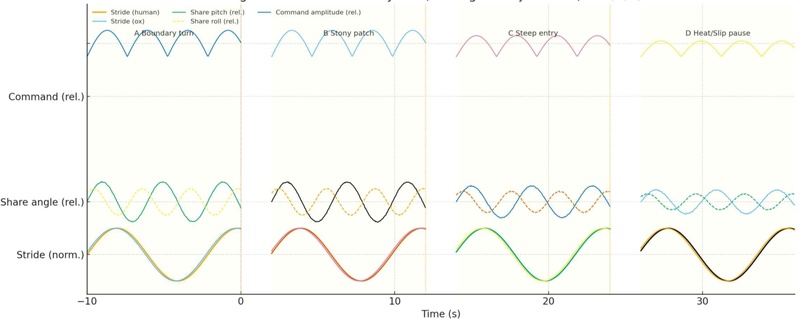
Event-based rhythm schematic (act–signal–adjustment triad), including relative Sg/Ac variation. Data source: anonymised field codes
5.2 Immediate Adjustment to Terrain/Soil Signals
Abrupt slope changes, stony clusters, shallow effective depth, micro-steps/stone walls, and narrow approaches function as salient signals. Just before entering stony segments, command syllables shorten and stress rises, while share roll exhibits fine oscillations ([A-2024-05-14]). On steep entries, forward velocity is reduced and the ox’s head angle raised to mitigate rollover risk; the share pitch is lowered to skim the topsoil and limit loss ([D-2024-08-19]). This act → signal perception → immediate adjustment loop recurs; with repetition, adjustment amplitudes decrease and response times shorten, indicating skill stabilisation.
5.3 Turn Optimisation in Elongated Patches
Most parcels are elongated with tight turning constraints. The observed strategy maximises straight passes along the long axis, leaves a shallow buffer strip along the boundary/stone wall, then executes a U-turn re-entry ([C-2024-07-03], [B-2024-06-22]). The buffer absorbs impact on the share/nose during turning and simplifies subsequent soil finishing/repairs. At boundaries, commands lengthen to disyllabic forms; stride contraction and ankle-angle control co-occur to prevent slipping. Continuous S-turns are avoided in stony segments, where they accumulate fatigue and risk. See Figure 2 for the comparative schematic.
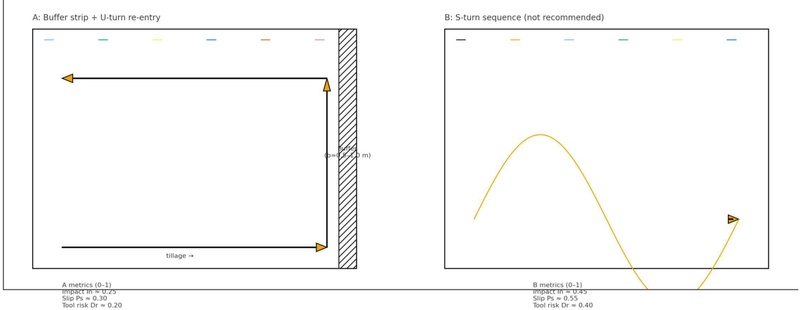
Turning strategy in elongated plots (buffer strip + U-turn re-entry), contrasted with Strategy B (S-turns). Coordinates generalised; identifiers removed
5.4 Risk Management and the ‘Pause’ Operating Rule
During the monsoon and hot season, heat and slip risks for humans and oxen increase. When elevated perceived temperature, surface sheen (excess moisture), and reduced wind are co-detected, a four-step pause protocol—stop → settle → wait → resume—is triggered immediately ([E-2024-07-28]). Activation was most frequent on upland fields around ~15°; accepting short-term efficiency loss prevented accidents and cumulative fatigue, stabilising productivity over the full cycle. Risk management is not an add-on but designed into the rhythm.
5.5 Reorganisation of Labour and Circulation (‘Reverse Scheduling’)
Communal ox ownership and village-scale pumassi have largely shifted to individual operation, yet informal sharing of tools/know-how persists in high-load phases (e.g., post-monsoon re-finishing, removal of large stones) ([F-2024-09-02]). Ox purchase/movement/veterinary care follow institutionalised channels; when licensed-transport and clinic timetables align with market days, the farm calendar is re-composed from the outside in—a reverse scheduling anchored to external windows ([G-2024-05-09]). This indicates that the economics of maintaining ox-based work are tightly coupled to time–distance–cost constraints.
5.6 Threshold Structure of Persistence and Extinction Pressures
Persistence is observed where three conditions converge: (a) a physical mosaic of abrupt slopes, stony segments, shallow soils, and narrow approaches; (b) accumulated event-scale rhythmic skill (stride synchrony, fine share adjustments, prosodic modulation); and (c) a minimal logistical infrastructure (mobility, veterinary care, spares). Conversely, (a′) widening approaches and parcel consolidation, (b′) removal of stone walls and deepening of soils, and (c′) constant availability of custom-hire machinery lower the marginal cost of mechanisation and raise substitutability, thereby intensifying extinction pressure. Extinction accelerates not from any single factor, but when threshold combinations are met (synthesis of field records). See Figure 3.
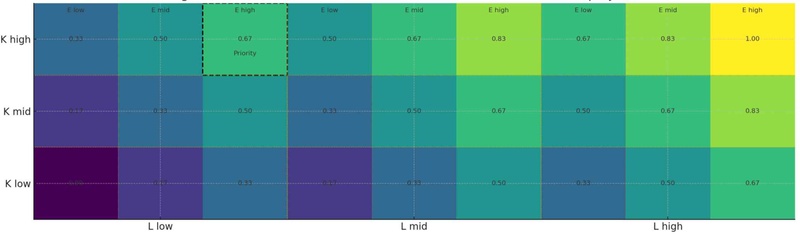
Persistence/extinction threshold matrix (environment–skill–infrastructure): conceptual decision-support schematic
5.7 Model Feedback: Generality and Limits of ‘Act–Signal–Adjustment’
The findings reaffirm ox-ploughing as a co-production of terrain–technique–society. Micro-constraints of terrain/soils demand adjustable rhythms; stabilised rhythms organise risk management and labour norms; social/logistical constraints re-compose calendars and the choice of tools/animals. The proposed act–signal–adjustment model appears generalisable to cooperative techniques among smallholders on mountain slopes, but on planar, large-scale fields the rhythm’s design becomes machine-centred, reducing explanatory power. Applicability should thus be bounded to small, elongated patches in mosaic terrain.
5.8 Robustness Checks: Negative Cases and Triangulation
Where slopes were moderate yet ox-work persisted, the causes combined habitual skill/lexicon, distributional constraints, and lack of custom-hire availability ([H-2024-10-05]). Conversely, a few steep plots had been converted to small-tractor work after side-slope stabilisation, stone-wall removal, and soil improvement ([I-2024-09-11]). Triangulation across interviews, observations, and sketches reproduced the core categories—micro-mobility, rhythmic stabilisation, and reverse scheduling—and member checking secured terminological consistency.
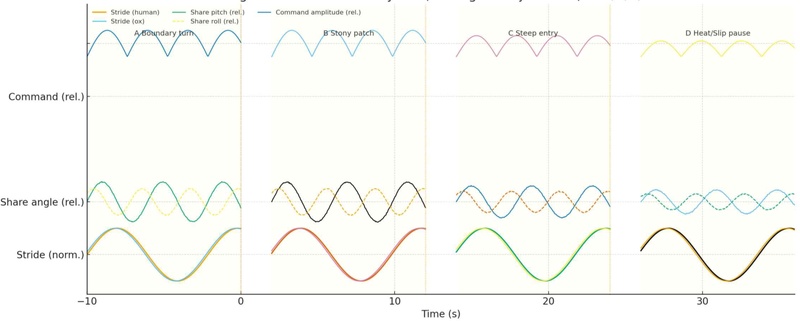
Event-based rhythm schematic (act–signal–adjustment triad), including relative Sg/Ac variation. Data source: anonymised field codes
6. Discussion
This study relocates ox-ploughing from a “past to be preserved” to a present technique rationally chosen under the constraints of terrain, soils, and distributional institutions. In a mosaic environment where abrupt slope shifts, stony segments, shallow effective soil depth, and narrow approaches converge, ox-ploughing supplies micro-mobility that can exceed the marginal efficiency of mechanization, while managing risk through skillfully stabilized work rhythms. Theoretically, this concretizes core insights of STS and multispecies scholarship—actor–network co-constitution and ecological co-presence (Latour, 2005; Haraway, 2008; Kirksey & Helmreich, 2010)—at the event scale of smallholder practice on slopes.
Our analytic frame—summarized as act–signal–adjustment—braids an anthropological account of skilled technique as rhythm (Ingold, 2000) with agricultural-engineering knowledge of physical risk on slopes (FAO, 2006). We show, at field level, that immediate adjustments to environmental signals (slope, stoniness, micro-steps) recur as event loops—stride synchrony, fine share angle/depth correction, prosodic modulation of commands—and that repetition yields variance reduction rather than skill decay. This advances a rhythm-based theory of technique that moves beyond both material reductionism (“technology = tool properties”) and cultural reductionism (“technology = discourse/ideas”).
Turning technique and buffer-strip management emerge as core micro-technologies that jointly secure productivity and safety in elongated plots. A shallow tilled buffer along boundary stone lines absorbs turning shocks and eases next-cycle repairs, while U-turn re-entry suppresses fatigue accumulation in stony segments. These findings align with slope-safety guidance (HSE, 2024; Vigoroso et al., 2019) yet fill a gap by articulating animal-traction-specific operating solutions.
The effects we conceptualize as reverse scheduling show that persistence hinges not only on technique and micro-environment, but on time–distance–cost structures. When cattle-market days, licensed-transport availability, and veterinary windows braid together, institutional–logistics infrastructures indirectly govern technical choice by re-composing the farm calendar from the outside in. This resonates with evidence on the reorganization of livestock/by-product distribution (KREI, 2015) and elevates the minimal infrastructure conditions for maintaining animal traction to the level of policy concern.
On research ethics and data governance, standardized anonymized codes, coordinate generalization, and progressive removal of identifiers provide operational rules for working with “living techniques,” where privacy, property, and animal-welfare issues are intrinsic. Coupled with oral-history method (Yow, 2015; Portelli, 1991), these rules function as a practical model that minimizes the tension between documentation and protection while preserving auditability.
Generalisability is bounded to mountain/sub-mountain settings that meet the joint conditions of small elongated patches + mosaic terrain + minimal logistics infrastructure. On planar, large parcels or where approaches have been widened, the act–signal–adjustment rhythm is likely absorbed into machine-centred SOPs, reducing the model’s explanatory power. Even so, event-and-rhythm analysis can extend to adjacent domains—orchard work on slopes (e.g., grapes/apples), terrace-paddy maintenance, and hybrid small-equipment/animal-traction sequences.
7. Conclusion
Drawing on the Gowun-ri case, this study demonstrates that ox-ploughing continues to function as a rational option within the interaction of terrain, technique, and society. In a mosaic of slope, stoniness, soil depth, and approach constraints, ox-ploughing manages risk and secures productivity through a rhythm composed of stride synchrony, fine share adjustments, and prosodic command modulation. In parallel, distributional and institutional infrastructures restructure the operational calendar via reverse scheduling.
The theoretical contributions are threefold. First, we operationalize STS and multispecies perspectives at the event scale of smallholder work on slopes. Second, by defining technique as rhythm-based, we offer an analytic that exceeds material and cultural reductionisms. Third, we redefine the environmental rationality of animal traction—an aspect underemphasized in studies of motorization.
Methodologically, the combination of data governance (anonymization, coordinate generalization, audit trail) with rhythm analysis + sketch mapping provides a procedure for translating a living technique into a verifiable and reproducible narrative—meeting, at once, the ethics and replicability standards of oral history, ethnography, and the history of technology.
Policy and practice implications include: targeted support for micro-scale stone-terrace maintenance and repair; access and turning-space improvements designed for hybrid ox–machine operation; ensuring continuity of licensed transport and veterinary services; and field training on heat/slip-index-based stop rules.
These recommendations call for a shift from treating ox-ploughing as mere “experiential heritage” to recognizing it as a situationally effective field option.
Limitations stem from the in-depth, single-village/household design; generalization is appropriate only to analogous environments. Future work should include (i) comparative ethnography (other regions, draft animals, crop systems), (ii) synchronous sensor–audio–video recording for quantitative rhythm analysis, and (iii) optimization studies of hybrid machine–ox sequences.
Ultimately, the study restores ox-ploughing as a locally rational technique, not a residual of the past. It offers a language of work rhythms needed to rethink the sustainability of mountain agriculture and a respectful mode of recording local agrarian knowledge. Gowun-ri’s “last ox-ploughing” testifies to the present-tense adaptability of technique beyond the simple binary of extinction versus preservation.
Statements and Declarations
Author Contributions: Conceptualisation, Y.N.; methodology, Y.N.; software, Y.N.; validation, Y.N.; formal analysis, Y.N..; investigation, Y.N.; resources, Y.N.; data curation, Y.N.; writing—original draft preparation, Y.N.; writing—review and editing, Y.N.; visualisation, Y.N.; supervision, Y.N.; project administration, Y.N.; funding acquisition, Y.N. All authors have read and agreed to the published version of the manuscript.
Funding: This work was supported by the Ministry of Education of the Republic of Korea and the National Research Foundation of Korea(NRF-2023S1A5C2A02095114)
Institutional Review Board Statement: The study was conducted according to the guidelines of the Declaration of Helsinki and approved by the Institutional Review Board of Konkuk University (IRB: KKUIRB-202503-HR-050).
Informed Consent Statement: Informed consent was obtained from all participants involved in the study.
Data Availability Statement: The data presented in this study are available on reasonable request from the corresponding author.
Acknowledgments: We would like to thank Editage (www.editage.co.kr) for English language editing. We would also like to thank the industrial safety experts who assisted with this research.
Conflicts of Interest: The authors declare no conflict of interest.
Reference
- Academy of Korean Studies. (n.d.). Dure [traditional communal labor]. In Encyclopedia of Korean Culture. Retrieved October 1, 2025, from https://encykorea.aks.ac.kr/Article/E0016972
-
Callon, M. (1984). Some elements of a sociology of translation: Domestication of the scallops and the fishermen of St Brieuc Bay. The Sociological Review, 32(S1), 196–233.
[https://doi.org/10.1111/j.1467-954X.1984.tb00113.x]

- Food and Agriculture Organization of the United Nations. (2006). Guidelines for soil description (4th ed.). FAO. Retrieved October 1, 2025, from https://www.fao.org/4/a0541e/a0541e.pdf
- Ginzburg, C. (1980). The Cheese and the Worms: The cosmos of a sixteenth-century miller. Baltimore, MD: Johns Hopkins University Press.
- Haraway, D. J. (2008). When species meet. Minneapolis, MN: University of Minnesota Press.
- Health and Safety Executive. (2024, December 9). Overturning tractors and other self-propelled vehicles: Work safely on slopes. Retrieved October 1, 2025, from https://www.hse.gov.uk/agriculture/topics/machinery/farm-vehicles-2.htm
- Ingold, T. (2000). The perception of the environment: Essays on livelihood, dwelling and skill. London, UK: Routledge.
-
Kirksey, S. E., & Helmreich, S. (2010). The emergence of multispecies ethnography. Cultural Anthropology, 25(4), 545–576.
[https://doi.org/10.1111/j.1548-1360.2010.01069.x]
- Kookmin Ilbo. (2010, December 1). All 84 livestock markets nationwide closed. Retrieved October 1, 2025, from https://www.kmib.co.kr/article/view.asp?arcid=0004387828
- Korean Society of Agricultural History. (n.d.). Journal of Agricultural History: Journal information and index. Korean Citation Index (KCI). Retrieved October 1, 2025, from https://www.kci.go.kr/kciportal/po/search/poCitaView.kci?sereId=002142
-
Latour, B. (2005). Reassembling the social: An introduction to actor-network-theory. Oxford, UK: Oxford University Press.
[https://doi.org/10.1093/oso/9780199256044.001.0001]
- Ministry of Government Legislation. (n.d.). Act on the Promotion of Agricultural Mechanization. National Law Information Center. Retrieved October 1, 2025, from https://www.law.go.kr/LSW/lsInfoP.do?lsId=000454
- National Institute of Korean Language. (n.d.). Gyeori [entry]. In Standard Korean Language Dictionary. Retrieved October 1, 2025, from https://stdict.korean.go.kr/search/searchView.do?word_no=16733
- National Safe Tractor and Machinery Operation Program. (2013). Task Sheets, Section 4: Agricultural Tractors (ed. W. Harshman, A. Yoder, J. Hilton, & D. Murphy). Penn State University. Retrieved October 1, 2025, from https://agsafety.psu.edu/nstmop-program-overview/
- Portelli, A. (1991). The death of Luigi Trastulli and other stories: Form and meaning in oral history. Albany, NY: SUNY Press.
- Schulte, E. E., Walsh, L. M., Kelling, K. A., Bundy, L. G., Bland, W. L., Wolkowski, R. P., Peters, J. B., & Sturgul, S. J. (2005). Management of Wisconsin soils (A3588). University of Wisconsin–Extension. Retrieved October 1, 2025, from https://corn.agronomy.wisc.edu/Management/pdfs/A3588.pdf
- Shaxson, F. (1999). New concepts and approaches to land management in the tropics with emphasis on steeplands (FAO Soils Bulletin No. 75). FAO. Retrieved October 1, 2025, from https://openknowledge.fao.org/server/api/core/bitstreams/33064b35-6ab8-4dc8-8799-6b04d40bc27f/content
- Song, W., Lee, H., & Seo, G. (2015). Improving the distribution structure of livestock by-products (Research Report R773). Korea Rural Economic Institute (KREI). Retrieved October 1, 2025, from https://repository.krei.re.kr/handle/2018.oak/21463
- The Nongmin Newspaper. (2015, August 13). Feature: 70 years of independence, 70 years of farming technology. Retrieved October 1, 2025, from https://www.nongmin.com/article/20150813095545
-
Toscano, P., Cutini, M., Cabassi, G., Pricca, N., Romano, E., & Bisaglia, C. (2022). Assessment of a deep burial destoning system of agrarian soils alternative to stone removal and on-site crushing. AgriEngineering, 4(1), 156–170.
[https://doi.org/10.3390/agriengineering4010011]
-
Vigoroso, L., Caffaro, F., & Cavallo, E. (2019). Warning against critical slopes in agriculture: Comprehension of targeted safety signs in a group of machinery operators in Italy. International Journal of Environmental Research and Public Health, 16(4), 611.
[https://doi.org/10.3390/ijerph16040611]
-
Yow, V. R. (2015). Recording oral history: A guide for the humanities and social sciences (3rd ed.). Lanham, MD: Rowman & Littlefield.
[https://doi.org/10.5040/9798216401568]
Appendix
Appendix

Codebook Summary (Open–Axial–Selective Coding; Representative Excerpts and Notes)
Younghee Noh has an MA and PhD In Library and Information Science from Yonsei University, Seoul. She has published more than 50 books, including 3 books awarded as Outstanding Academic Books by Ministry of Culture, Sports and Tourism (Government) and more than 120 papers, including one selected as a Featured Article by the Informed Librarian Online in February 2012. She was listed in the Marquis Who’s Who in the World in 2012-2016 and Who’s Who in Science and Engineering in 2016-2017. She received research excellence awards from both Konkuk University (2009) and Konkuk University Alumni (2013) as well as recognition by “the award for Teaching Excellence” from Konkuk University in 2014. She received research excellence awards form ‘Korean Library and Information Science Society’ in 2014. One of her books, published in 2014, was selected as ‘Outstanding Academic Books’ by Ministry of Culture, Sports and Tourism in 2015. She received the Awards for Professional Excellence as Asia Library Leaders from Satija Research Foundation in Library and Information Science (India) in 2014. She has been a Chief Editor of World Research Journal of Library and Information Science in Mar 2013 ~ Feb 2016. Since 2004, she has been a Professor in the Department of Library and Information Science at Konkuk University, where she teaches courses in Metadata, Digital Libraries, Processing of InterSnet Information Resources, and Digital Contents.