
Integrating Practice into LIS Curriculum: Internship Experiences at IIT Delhi
© Author(s), 2026.
Licensed under CC-BY-NC-ND 4.0.
'Tell me and I forget. Teach me and I remember. Involve me and I learn'.
—Benjamin Franklin.
Abstract
Internships play a vital role in developing practical experience and professional skills among students. In alignment with India's National Education Policy (NEP) 2020, which emphasises experiential learning, this study examines the curriculum-based internship program undertaken by MLIS students at the Central Library, IIT Delhi. Using a structured questionnaire, the study surveyed students' perceptions of the skills gained during their internship. Quantitatively, the study revealed that nearly half of the students completed the internship in their second semester, with 84.6% undertaking a one-month program. All respondents reported a highly positive experience and deemed the internship relevant to their future careers. Professional and communication skills were widely enhanced, although opinions varied regarding technical skills. Most of the students suggested extending the internship duration. The study identifies the challenges faced during the internship and offers recommendations for improvement. As an original case study, it will serve as a model for other academic libraries.
Keywords:
Curricula Internship, MLIS Curriculum, Practical Training, NEP 2020, Professional Skills, Symbiotic Partnership1. Introduction
LIS curricula are designed to fulfil market demands by incorporating internships or field experiences. These internships inculcate confidence and professional skills in the students. LIS internships involve various stakeholders, such as faculty supervisors, students, and host institutions (practitioners). Internships provide opportunities to interact with users and staff of the libraries, and symbiotically, they offer mutual benefits to host libraries and mentors. This collaborative approach enhances the learning experiences and helps in relating theoretical knowledge to the field conditions, and increases employability.
The National Education Policy 2020 in India mandates that higher education institutions (HEIs) offer internships to ensure holistic education, facilitate practical learning, and enhance employability (Ministry of Human Resource Development, Government of India, 2020, 11.8). Masters in Library and Information Science (MLIS/M.Lib.I.Sc.) in India is imparted by various Central/State Universities and private institutions through regular or distance mode, typically for one year (two semesters) or a two-year integrated program (four semesters). Keeping in view the NEP 2020 recommendation and the need for a practical-oriented curriculum, MLIS courses have a mandated provision of internship during the second/third/fourth semesters, focusing on professional and technical skills development. Library internships are essential to LIS education; hence, they should be evaluated, and appropriate guidelines should be laid out in the curriculum.
1.1 Background of the Study
There are several studies in which internship outcomes and future benefits were discussed. However, these studies have limited dissemination of pedagogy involved at host institutions for imparting practical skills to the curricula interns. In this study, we are talking about the practices involved and the enhancement of students' skills in the curricula internship program undertaken by Central Library, IIT Delhi. This paper will be a stepping stone for other academic libraries in India for strengthening and structuring the internship program and fostering institutional collaboration.
Indian Institute of Technology Delhi is one of the 23 IITs created to be a centre of excellence in training, research and development in science, engineering and technology in India. In the QS World University Ranking 2026, IIT Delhi emerges as the number one educational institution in India (About IIT Delhi, 2020). Central Library is a dynamic hub of knowledge for the institute. It has 36 Unit libraries in various departments, centres and schools. It offers many information services to its user community on and off campus. It mainly comprises the following divisions/sections: Computer Applications Division (CAD), Reader Services Division (RSD), Collection Development Division (CDD), Electronic Resources Division (ERD), Text Book, Book Bank (TBBB) Theses section (TH). It provides two types of internships; one is paid after completion of MLIS for a year, in which an intern can learn the functioning of the various sections of the central library/unit libraries while earning, and another is unpaid for catering the curriculum/course needs of MLIS programs of various universities. It is mainly for one month during the second/third semester or five months during the whole fourth semester (Library-Internship, 2026). This study covers the formal feedback shared by curricula interns to the host institution (IIT Delhi) internship coordinator. This study aims to determine the extent to which the internship has enhanced the students' skills.
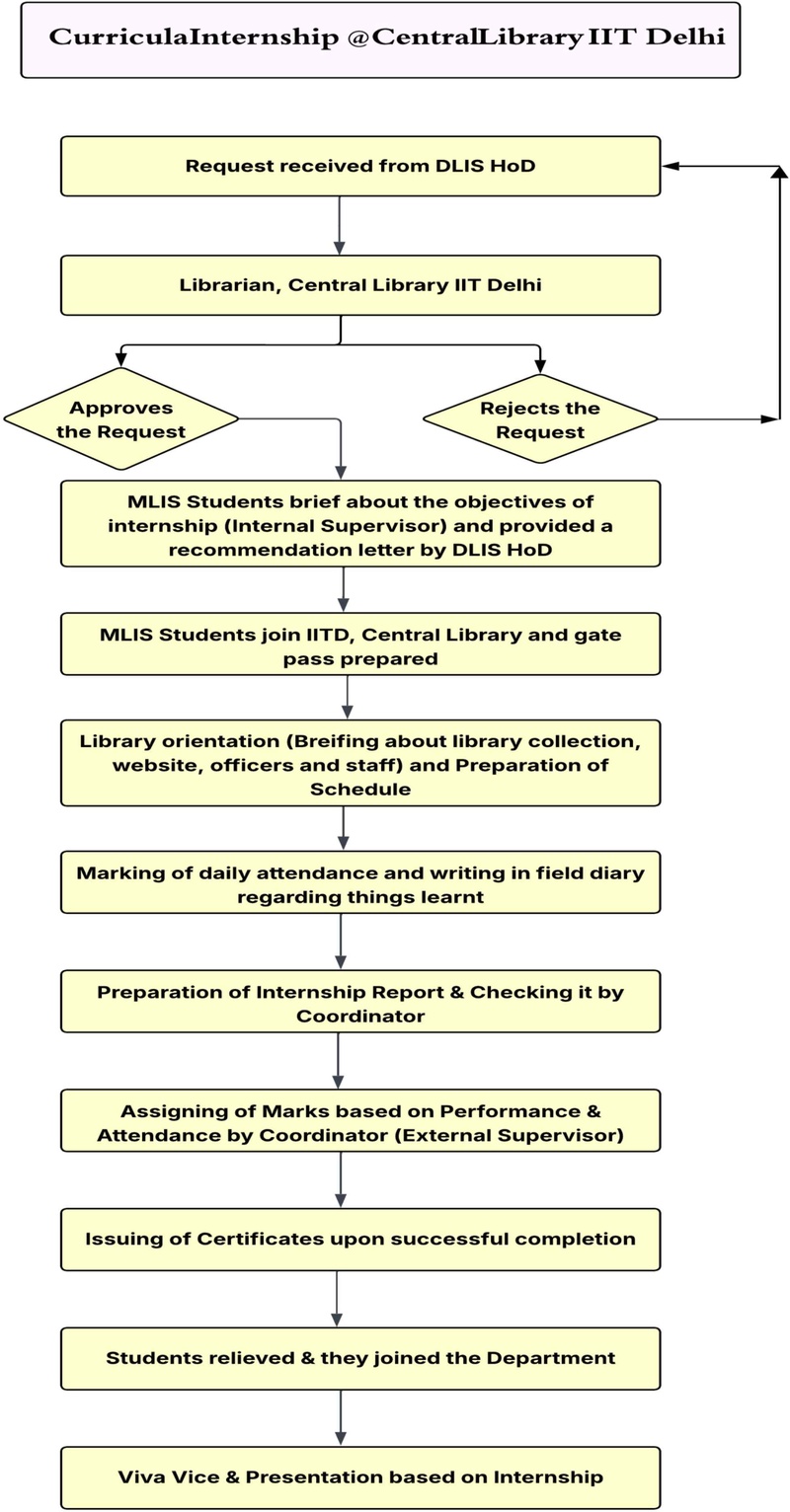
Flowchart of the Curricular Internship at IIT Delhi
2. Literature Review
Internships are an integral part of LIS education. The following themed literature has been reviewed to understand the attempts made to understand the strengths and weaknesses of such programs:
2.1 Importance
Several reported studies have discussed the role of internships in reducing the gap between theory and practice by introducing students to workplace realities (Ball, 2008). Internships function as a means of career preparation (as a foot in the door) and provide opportunities for personal exploration (as tasters) (Popov, 2025). Alam and Yesmin (2024) averred that internships need proper planning, assessing interns' progress, offering support and mentoring for designing a learning experience. Jordan and Matzke (2024) further highlighted that although experiential learning possesses a high value, internships are undervalued. Moreover, structured internships require commitment among various stakeholders.
Galbraith and Mondal (2020) advocated that internships are significant due to the professional connections and networking prospects they provide. They bring both the employer and the employee (student) together. According to Arif et al. (2018), MLIS interns were able to gain traditional library skills, but they need to learn more about technical skills. The interns were satisfied with the internship as it had developed professional skills and expanded job possibilities.
2.2 Mutually Beneficial
Bird et al. (2015) accentuated the four I's approach, which is an intentional, interconnected, interdisciplinary, and international model for a LIS internship. Here, students, faculty and practitioners have a clear understanding of the goals to be achieved. Such internships require the use of information and communication technologies. Bird and Crumpton (2014) explored a novel internship model that emphasized mutual learning among students, librarians (practitioners), and faculty. A three-year case study at the University of North Carolina in Greensboro conducted the Real Learning Connections project to address the enduring theory-practice gap in Library and Information Science (LIS). Lacy and Copeland (2013) talked about mentorship programs. They further said that mentees gained knowledge related to job seeking and workplace expectations. At the same time, mentors valued the experience as it strengthened their commitment to the profession, improved their understanding of the work, and kept them up-to-date with current knowledge. Asher and Alexander (2006) advocated that academic libraries can serve the profession by opening gates for internships, and library internships should always be for educational needs, not as a substitute for staff. Additionally, they emphasized that a library internship should be ethnically diverse.
2.3 Challenges
Despite the fact that internships have many benefits, the LIS graduate students' internship program still has to deal with a number of problems. These include incorrect placement procedures, internships being limited to the parent institution's library, inadequate supervision, a lack of funds to support interns' well-being, lectures running during the internship period, and differences in the learning facilities used in library school and the internship library, among other issues (Ebiye, 2015). Sharath and Rao (2024) listed challenges related to logistics, student involvement, and support from mentors in their paper.
2.4 Hybrid Internships
Sometimes, in-person internships are not possible, specially for distance learners. Hybrid internships can be offered to them. Wilson, Hawk and Miller (2022) conducted a case study of a graduate internship at Louisiana State University Libraries (US). Initially, it was intended to be in-person, but it was converted to a hybrid manner (predominantly virtual with minimal on-site involvement) due to the COVID-19 outbreak. In the same vein, Balbin and Dolendo (2023) examined the experiences of LIS students participating in a virtual internship program at Benguet State University during COVID-19. The study introduced a three-phase internship framework: pre-internship preparation, internship, and post-internship evaluation.
While the extant literature establishes different benefits of internships, challenges and hybrid internships, there is limited evidence available on the structure, duration and outcomes of curriculum internships. The present study will try to reduce the gaps by analyzing the perceptions of MLIS students.
3. Objectives of the Study
The following are the objectives of the study:
- a) To know the skills acquired by MLIS students during the internship,
- b) To examine the relevance of curricula internship for job, and
- c) To know the problems they confronted during the internship.
4. Hypothesis of the Study
H1: There is no significant difference in students' internship experiences with respect to gender.
H2: There is no significant difference in students' perceptions of the relevance of the internship for their job with respect to gender.
5. Methodology
It is essential to get feedback from curriculum interns from the libraries that undertake internship programs. The study used a survey approach, which encompassed a quantitative approach. A structured online questionnaire was prepared using Google Forms, keeping in mind the objectives of the study. The questionnaire has two parts: the first part consists of demographic variables, and the second part contains students' perception of the internship program regarding its effectiveness and rating a series of statements regarding skills developed using a 5-point Likert scale ranging from 1- strongly disagree to 5- strongly agree, respectively. The data was collected from curricula interns who have done the internship from January 2023 to June 2025 from various universities/institutes in India. The questionnaire was shared through WhatsApp or email to 45 interns, and a total of 26 (58% response rate) were filled. The questionnaire reliability was tested using Cronbach's alpha, and it was found to be 0.92 across 15 items, indicating excellent internal consistency.
5.1 Data Analysis
The collected data were analyzed in MS Excel using descriptive statistics (frequencies, percentages, mean, median, mode, and standard deviation) and inferential statistics, including independent sample t-tests on relatively small sample size (N = 26).
6. Results
The findings of the study are based on the quantitative data collected through an online questionnaire.
6.1 Demographic profile of the respondents
The first part of the questionnaire consists of the demographic variables (independent) of respondents. It was designed to collect data pertaining to gender, students' affiliations, study level and the duration of the internship.
According to Table 1, 61.5% of female students and 38.5% of male students have undertaken a curricular internship at the Central Library, IIT Delhi. As per the affiliations, MLIS students from all over India join internships at the Central Library, IIT Delhi, as requested by their Heads of Departments (HoDs). Currently, as per the survey from Indira Gandhi National Open University (IGNOU), 19.2% of MLIS students have undergone internships, followed by the Central University of Tamil Nadu (CUTN) with 15.4% of MLIS students, followed by the Central University of Gujarat (CUG) and Haryana (CUH), with 11.5% students. This is followed by Central University of Himachal Pradesh (CUHP), Tata Institute of Social Sciences, Mumbai (TISS), and University of Calicut, Kerala, with 7.7 % students. Central University of Punjab (CUP), Documentation Research and Training Centre (DRTC), Bangalore, and Manipal Academy of Higher Education (MAHE), Bangalore, 3.8% students each participated and have recently only sent their students for internships at the Central Library, IIT Delhi. The University of Kerala used to send their students frequently, but during the survey, only one student responded.

Demographics of Curricula Interns
Mostly, 50% of the students have undergone internships during their second semester. Only 7.7% of students undertook internships during their I III semesters. About 15.4% of students have taken an internship during the IV semester. Central University of Haryana (CUH) has a structured internship for 5 months during the IV semester, and 11.5% of students have undertaken the internship. IGNOU, being an open university, has flexibility, resulting in a higher percentage of internships among students. About 84.6% of students undertook one-month internships at IIT Delhi, and one student from Manipal Academy of Higher Education (MAHE) has undertaken a 45-day internship. The above data highlights the varying internship opportunities available to students across various universities.
6.2 Experience during the MLIS internship program
An independent-samples Welch's t-test was conducted to compare internship experiences across gender, measured on a 4-point Likert scale ranging from 0 (Poor) to 4 (Excellent). Female students (M = 3.88, SD = 0.34, n = 16) reported slightly lower experience ratings compared to male students (M = 4.00, SD = 0.00, n = 10). The difference was not statistically significant, t(15) = –1.46, p = 0.164.
At the 0.05 significance level, the null hypothesis was not rejected, indicating that students' internship experiences do not differ significantly by gender. Due to the small sample size (N = 26) and no variability in the male group (Cohen's d=0.46), results should be interpreted cautiously. The findings suggest uniformly high satisfaction levels across both genders.
6.3 Relevance and helpfulness of an internship for the job
Analysis of students' ratings on a 5-point Likert scale ranging from 1 (Not very) to 5 (Very Much) showed that both male (M = 4.9) and female (M = 4.63) students perceived the internship at the Central Library, IIT Delhi, as very much relevant and helpful for their job. An independent-samples t-test indicated that the difference was not statistically significant, t(24) = -1.7, p = 0.098. Therefore, H2 is supported, confirming absence of statistical significance, and indicating strong agreement that the internship was relevant and helpful for future employment. However, Cohen's d = 0.63, this means the difference between male and female perceptions is moderate-to-large.
6.4 Skills development through the Curricula Internship
Skills Developed through the Curricula Internship
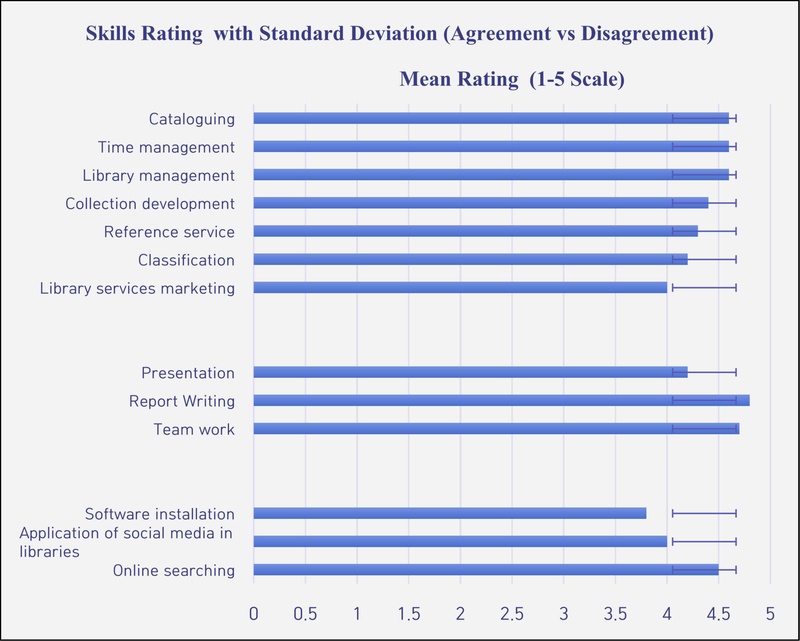
Mean Skills Rating with Standard Deviation
Development of Professional Skills: Overall, High scores (mostly between 4.2 – 4.6) show strong agreement that professional skills are well-developed after the internship. Cataloguing (Mean=4.6, SD=0.58): Shows high consistency, most respondents agree/strongly agree. Time management Library management (Mean=4.6, SD ~0.7–0.85): Mostly agree/strongly agree but have slight variation. Collection development (Mean=4.4, SD=0.76): Well-rated with moderate consistency. Reference service (Mean=4.3, SD=0.92): Good rating, but higher variability means mixed opinions. Classification (Mean=4.2, SD=0.95): Slightly lower than others, but still positive. Library services (Mean=4, SD=1.13): Agreed, but the highest variation means some disagreement among respondents.
Professional skills are perceived as strong, especially cataloguing, time management, and library management. However, reference service, classification and library services marketing show slightly more varied opinions.
Development of Communication Skills: Presentation (Mean=4.2, SD=1.18): Agreed, but wide variation, which means some respondents rated low. Report writing (Mean=4.8, SD=0.51): Strongly agree and consistent agreement. Teamwork (Mean=4.7, SD=0.67): Highly rated, low variation.
Development of Technical Skills: Software installation (Mean=3.8, SD=1.12): Lowest mean score; mixed responses, some disagreement. Application of social media in libraries (Mean=4.0, SD=1.23): Agreed, but high variation. Online search (Mean=4.5, SD=0.95): Strongest technical skill, though some variation.
Technical skills are comparatively less developed, particularly in software installation and the application of social media in libraries. Students need to spend more time on computer applications so that their technical skills can be adequately developed.
However, overall mean scores across professional, communication, and technical skills ranged from 3.8 to 4.8, indicating generally strong agreement that the internship contributed to skill development.
6.5 Sufficient opportunities to work on different areas of library operations
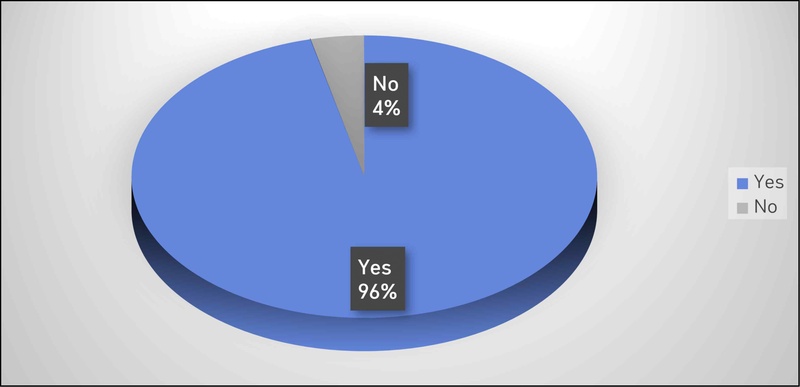
Mean Skills Rating with Standard Deviation
The majority (96%) of the students said they were given sufficient opportunities to work on different areas of the Central Library, such as the Reader Services Division, Computer Applications Division, Collection Development Division, Electronic Resources Division, Text Book, Book Bank and Theses Section.
6.6 Guidance from the library staff
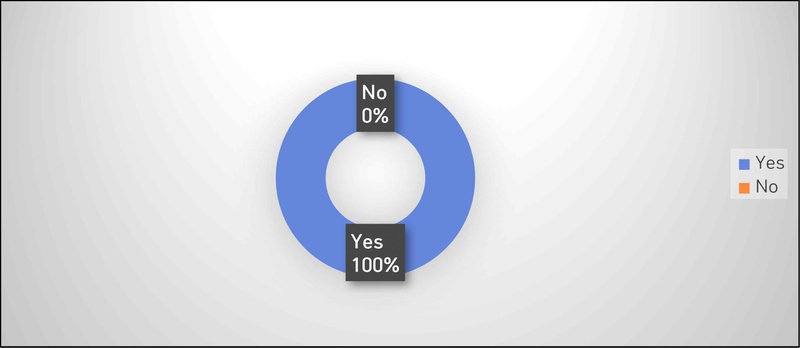
Guidance from the Library Staff
All the respondents said they got adequate guidance from the library staff of the Central Library, IIT Delhi.
An intern cited, "During my 1-month internship, the main challenges I faced were adapting to the professional environment and understanding the daily routines of a functioning library in such a short period. Tasks like cataloguing, classification, and managing circulation services required quick learning, and doing all this without prior hands-on experience was also challenging. However, the staff were very friendly and helpful and they supported me throughout my internship."
6.7 Challenges faced during the internship
The students said that the following challenges they came across during their internship at the Central Library, IIT Delhi:
- i. Language barrier: Many of them came to Delhi for the first time, some of them were from the southern part of India, where Hindi is not widely spoken, and a few were not confident in English. This has created communication and interaction difficulties in both professional and social contexts.
- ii. Food and Accommodation issues: Adjusting to the local food of Delhi posed a challenge for several students. In addition, finding suitable accommodation was a significant concern, particularly for those new to the city.
- iii. Adjusting to a new culture: As 78% of students live outside Delhi, they find the culture of Delhi different from their native place.
- iv. Gap between theory and practice: These MLIS students found a gap between their curriculum and the practical work at the library. Although they have developed professional skills, but they have to stress on technological skills to match the demands of modern library services.
6.8 Suggestions for improvement
The students have given a few suggestions. These are:
- v. Increasing the duration of the internship: 65% of them had done an internship for a month only. They want their curriculum internship to be two/three months long.
In the words of an intern, "The internship was well organized, and the staff were very supportive. However, I think it would be helpful if interns got more time to work in each section, a longer duration could help us understand the work better.“
Another intern, "There was so much to learn and that was not possible to grasp in a month but I tried my best to absorb the knowledge as much as possible in that particular time.“
- vi. More emphasis on technical skills: They want to provide more time to learn computer applications, so that they can also develop technical skills.
- vii. Bridging the gap between theory and practice: The MLIS curriculum should be designed in a way that matches the needs of present library systems in India.
- viii. Development of Internship manual: Proper internship manual/guides should be developed so that what learning experiences are to be imparted to the students should be understood by the institutions (Cabfilan et al., 2025).
- ix. No classes during internship: Internship should be appropriately structured in the MLIS curriculum, and there should be no online theory classes during the internship period. Students should be spared completely so that they can learn and imbibe skills.
7. Discussion
The present study highlights the advances on skill acquisition by interns. The findings show that traditional skills (Classification and Cataloguing) are more reinforced through the internship, and technical skills require more structural integration. The study will surely have implications for redesigning the curriculum for the emerging digital libraries ecosystem.
Further, the study has identified a few barriers such as language barriers, accommodation constraints, and theory-practice gaps, which underscores that internship effectiveness lies beyond academic structure to the socio-cultural environment and puts additional responsibility on the institutions for proper mentoring of the students and extending the internship durations.
Moreover, the study positions curriculum-based internships as a pedagogical tool for supporting competencies, facilitating professional socialization, and enhancing employability, aligning with the National Education Policy (NEP 2020).
8. Conclusion
The present study signifies the importance of embedding internships in the MLIS curriculum in Indian universities. The findings of the study highlight the role of internship in increasing employability by exposing students to various library operations and inculcating the skills. The results of the present research align with the survey by Arif et al. (2018). The study also advocates that the duration of the internship should be increased.
The importance of the present study also lies in the fact that the curricula internship creates a symbiotic partnership between LIS schools and practitioners. This partnership is bringing mutual benefits to both. Curricula internship is honing the professional skills of MLIS students by providing them with practical learning exposure in real-world settings and bridging the gaps between academic knowledge and professional practice. The internship at the Central Library, IIT Delhi, facilitates professional networking as interns participate in various seminars and workshops conducted during their internship period. Thus, it enhances employability. Not only this, but an internship also brings an additional workforce that helps the library undertake tenacious tasks like weeding, stock verification, shifting of collection, etc. The interns sometimes bring fresh ideas to offer new and better services to the user community. Also, they are keeping the knowledge of the staff updated and generating mutual learning. The curricula internship strengthens ties with the LIS schools and builds a sustainable collaboration of mutual growth. It helps LIS schools keep up their curriculum with the needs of modern libraries. To bring structured improvements in curricula internship, it should be evaluated at both ends.
9. Limitations of the Study
The internship program involves three key stakeholders: faculty, students, and practitioners. However, the present study is limited to the perception of a few MLIS students who joined the Central Library, IIT Delhi, from January 2023 to June 2025 for the internship only. The absence of faculty and practitioners' perspectives is a major limitation. Future research should incorporate the views of all stakeholders to provide a more holistic evaluation.
Statements and Declarations
Author Contributions: The author was responsible for all aspects of the study, including conceptualization, data collection, analysis, and manuscript preparation.”
Funding: “This research received no external funding.
Data Availability Statement: Not applicable.
Institutional Review Board Statement: Not applicable.
Acknowledgements: The study is the outcome of feedback collected from MLIS students' interns who joined the Central Library, IIT Delhi. I thank the interns for providing valuable information by filling out the questionnaire.
Informed Consent Statement: Informed consent was obtained from all participants involved in the study.
Conflicts of Interest: The authors declare no conflicts of interest.
Generative AI Use Statement: The author used ChatGPT (OpenAI, GPT-5.5) to enhance the linguistic clarity and readability of the manuscript. The tool was used solely for language improvement, and the author takes full responsibility for the article's content.
References
- About IIT Delhi. (2020). Indian Institute of Technology Delhi. Retrieved July 9, 2025, from https://home.iitd.ac.in/about.php
-
Alam, S., Yesmin, S. (2024). Bridging theoretical abstraction to professional practice: an assessment of LIS students' experience of their internship program. Global Knowledge Memory and Communication. In press.
[https://doi.org/10.1108/gkmc-09-2023-0364]

-
Arif, M., Nunes, J. M. B., Kanwal, S. (2018). Looking back, moving forward: An assessment of LIS internship programme in developing country's perspective. The Journal of Academic Librarianship, 44(5), 595–602.
[https://doi.org/10.1016/j.acalib.2018.06.011]
-
Asher, C., Alexander, J. O. (2006). The Library internship and expo as a pathway to diversity: A case study. Journal of Education for Library and Information Science, 47(1), 17.
[https://doi.org/10.2307/40324334]
-
Balbin, D. Jr. S., Dolendo, R. B. (2023). Virtual internship experiences of library and information science students during the pandemic. Journal of Information Science Theory and Practice, 11(3), 58–78.
[https://doi.org/10.1633/JISTaP.2023.11.3.5]
- Ball, M. A. (2008). Practicums and service learning in LIS Education. Journal of Education for Library and Information Science, 49(1), 70–82. https://www.jstor.org/stable/40323787
-
Bird, N. J., Chu, C. M., Oguz, F. (2015). Internship in LIS Education: An International perspective on Experiential Learning. IFLA Journal, 41(4), 298–307.
[https://doi.org/10.1177/0340035215596352]
- Bird, N. J., Crumpton, M. A. (2014). Real learning connections: Questioning the learner in the LIS internship. Journal of Education for Library and Information Science, 55(2), 89–99. https://files.eric.ed.gov/fulltext/EJ1074307.pdf
-
Cabfilan, N. W., Sibaen, N. W., Chi, D. T. P., Basa, L. A. (2025). Library and Information Science Internship: An assessment of positive experiences. Pakistan Journal of Information Management and Libraries, 27, 90–108.
[https://doi.org/10.47657/pjiml.2025.230]
- Ebiye, E. V. (2015). Graduate students internship experience and its impact on practical skills development in LIS Education: a survey. Library Philosophy and Practice, 1335. http://digitalcommons.unl.edu/libphilprac/1335
- Galbraith, D., Mondal, S. (2020). The potential power of internships and the impact on career preparation. Research in Higher Education Journal, 38, 1–9. http://files.eric.ed.gov/fulltext/EJ1263677.pdf
-
Jordan, M. P., Matzke, C. S. (2024). A roadmap for establishing a successful internship program in state capitals and beyond. Journal of Political Science Education, 21(1), 84–104.
[https://doi.org/10.1080/15512169.2024.2349533]
- Lacy, M., Copeland, A. J. (2013). The role of mentorship programs in LIS education and in professional development. Journal of Education for Library and Information Science, 54(2), 135–146. https://eric.ed.gov/?id=EJ1074120
- Library-Internship. (2026). Central Library, Indian Institute of Technology Delhi. Retrieved July 15, 2026, from https://library.iitd.ac.in/page/internship/
- Ministry of Human Resource Development, Government of India. (2020). National Education Policy 2020. Retrieved June 17, 2025, from https://www.education.gov.in/sites/upload_files/mhrd/files/NEP_Final_English_0.pdf
-
Popov, J. (2025). Motivation in internship: working to learn and learning to work. Journal of Vocational Education and Training, 77(5), 1502-1522.
[https://doi.org/10.1080/13636820.2025.2462957]
- Sharath, G. V. K., Rao, T. S. (2024, November 19). An exploration of introducing internships as an integral facet of distance learning in library and information science. Retrieved September 30, 2025, from https://jurnal.ugm.ac.id/v3/BIP/article/view/13808/5185
-
Wilson, K., Hawk, A., Miller, M. (2022). Implementing a hybrid internship during the COVID-19 Pandemic. New Review of Academic Librarianship, 29(1), 77–96.
[https://doi.org/10.1080/13614533.2022.2082989]
Dr. Vanita Khanchandani is currently serving as Assistant Librarian (Selection Grade) at the Central Library, Indian Institute of Technology Delhi. She is managing the Textbook, Book Bank, and Theses sections and coordinating the Central Library Internship Programme. She has previously served at the Defence Institute of Psychological Research, DRDO. She holds a Ph.D. and M.Phil. in Library and Information Science. Her academic qualifications also include B.Sc. (Botany Honours), B.Ed., BLISc, and MLISc. Her diverse research interests, which include marketing of LIS products and services, open access, public libraries, and e-learning, reflect her wide-ranging and intriguing academic pursuits.