
Non-designated Heritage as Local Cultural Landscape: Ritual, Memory and Custodianship in Chungju, South Korea
© Author(s), 2026.
Licensed under CC-BY-NC-ND 4.0.
Abstract
This study examines non-designated cultural heritage in Chungju, South Korea, as a local cultural landscape produced through the interaction of place, ritual practice, memory and custodianship. Across rural areas of Chungju, tombs, lineage shrines, Confucian academies, pavilions, steles, rock inscriptions and village ritual sites remain outside formal heritage designation, yet they continue to organise local understandings of ancestry, scholarship, loyalty, settlement and belonging. Drawing on field documentation from five areas of Chungju, the study analyses how these sites operate not as isolated cultural properties but as spatially embedded nodes within wider landscapes of remembrance and care. It shows that heritage value is produced through the relationship between material remains, riverine and hillside settings, ancestral rites, inscriptional evidence, local historical knowledge and everyday maintenance. At the same time, these landscapes are vulnerable when custodianship weakens, inscriptions disappear, ritual practices decline, landownership changes or surrounding landscapes are altered. The study contributes to social and cultural geography by conceptualising non-designated heritage as a relational cultural landscape rather than a residual category of unprotected heritage. The Chungju case demonstrates how locally specific practices of care and memory sustain heritage beyond formal recognition, while also revealing the limits of generalising lineage-based and ritual forms of custodianship across different cultural contexts.
Keywords:
Non-Designated Heritage, Local Cultural Landscape, Ritual Practice, Place-Based Memory, Custodianship, South Korea1. Introduction
1.1 Problem statement
Cultural landscapes are not only produced by monumental sites, officially protected places or nationally recognised heritage zones. They are also formed through smaller, less visible places where memory, ritual practice and everyday care remain embedded in local topographies. In many rural and regional settings, tombs, shrines, pavilions, steles, rock inscriptions, ritual sites and commemorative structures shape how communities remember ancestry, scholarship, loyalty, settlement and belonging. These sites may not always be formally designated as cultural heritage, yet they continue to organise social relations with the past through their location, use, maintenance and narrative associations.
This study examines such sites through the case of Chungju, an inland city in central South Korea. Rather than treating non-designated cultural heritage primarily as a problem of incomplete official recognition, the study approaches it as a form of local cultural landscape. This shift in emphasis is important. Official heritage designation provides legal protection, administrative visibility and access to conservation resources. However, many locally meaningful sites remain outside formal heritage categories. Their value is often generated not through monumentality or architectural rarity, but through spatial embeddedness, ritual continuity, lineage-based care, inscriptional memory and the repeated practices through which people maintain relationships with place.
In South Korea, local heritage landscapes are often shaped by historical forms of Confucian learning, lineage organisation, ancestral commemoration, village ritual and rural settlement. In Chungju, the sites considered in this study include seowon, or Confucian academy-shrine complexes associated with scholarly commemoration; pavilions linked to literary and scenic memory; lineage shrines and ancestral tombs maintained by descendants; commemorative steles recording filial, loyalist or official memory; rock inscriptions; royal placenta chamber remains; and village ritual places associated with communal protection and seasonal practice. These sites are distributed across five rural township-level areas of Chungju: Geumga-myeon, Dongnyang-myeon, Sotae-myeon, Angseong-myeon and Eomjeong-myeon.
The study’s central concern is how these places function as heritage within the cultural landscape despite their position outside formal designation. A tomb located on a hillside, a pavilion overlooking a river, a shrine behind a village or a stele standing beside a rural road cannot be understood adequately as an isolated object. Each site acquires meaning through its relationship to surrounding topography, settlement history, access routes, ritual practice, kinship memory and local historical knowledge. This makes Chungju a useful case for examining how heritage value is spatially and socially produced in ordinary regional landscapes.
The argument builds on the idea that heritage is not a fixed object inherited from the past, but a process through which people value, narrate, use and transmit selected traces of the past in the present (Harvey 2001; Smith 2006; Harrison 2012). It also draws on geographical approaches that understand heritage as spatially situated and relational, rather than detached from the landscapes in which it is encountered (Graham, Ashworth, and Tunbridge 2000; Ingold 1993). From this perspective, non-designated heritage is not merely a residual category below designated heritage. It is a set of place-based relationships through which material remains, social memory and repeated practices become mutually reinforcing.
At the same time, the study does not romanticise local heritage as naturally stable or community-based custodianship as automatically inclusive. Heritage landscapes are unevenly maintained. Some sites remain legible because descendants, lineage associations, village groups or local historians continue to care for them. Others become fragile when inscriptions disappear, ritual practice declines, descendants move away, landownership changes or the surrounding landscape is altered. These processes show that non-designated heritage is vulnerable not only to physical decay, but also to the weakening of the social and mnemonic relations that allow a place to be recognised as meaningful.
This point is especially important for an international readership because several of the Korean heritage forms discussed here do not have direct equivalents in other cultural contexts. A jeongryeogak, for example, is a commemorative pavilion or shrine-like structure erected to honour exemplary loyalty, filial piety or chastity under Confucian moral order. A byeolsinje is a communal tutelary ritual, often associated with village protection, seasonal renewal or local guardian deities. A daegammyo literally means a “high official’s tomb” and is used here as a local memory term for a tomb attributed to a person of elite official status, even when the inscriptional evidence is weak or absent. Explaining these terms is essential because the spatial and social significance of the sites depends on cultural practices of remembrance, status, descent and ritual care.
The Chungju case therefore contributes to social and cultural geography by showing how non-designated heritage operates as a local cultural landscape. It foregrounds the spatial organisation of memory, the ritual activation of place and the labour of custodianship. It also shows that the tangible and intangible dimensions of heritage are difficult to separate. Tombs, steles, pavilions and shrines are materially present, but their value depends on intangible practices such as ancestral rites, inscription reading, genealogical knowledge, local storytelling, seasonal visits and everyday maintenance. The study thus examines heritage as a situated landscape practice rather than as a category defined only by formal recognition.
1.2 Research aim and questions
The aim of this study is to analyse how non-designated cultural heritage in Chungju is produced, sustained and made vulnerable as a local cultural landscape. The study focuses on the interaction of landscape, ritual practice, place-based memory and custodianship. It asks how small-scale sites outside formal designation continue to organise local relationships with the past, and how those relationships change when the social, material or spatial conditions of heritage care are weakened.
The study develops a landscape–ritual–memory approach to examine these processes. “Landscape” refers to the spatial embeddedness of heritage in rivers, hills, village edges, burial grounds, roads, former settlement areas and ritual routes. “Ritual practice” refers to repeated acts that activate or maintain a site, including ancestral rites, shrine rituals, commemorative visits, seasonal care and local forms of maintenance. “Memory” refers to the narratives, inscriptions, genealogies, oral accounts and affective attachments through which places are interpreted as historically meaningful. “Custodianship” refers to the actors and practices through which responsibility for heritage is assumed, including descendants, lineage associations, village residents, local historians, cultural organisations and municipal actors.
The study addresses four research questions:
RQ1. How are non-designated cultural heritage sites in Chungju embedded in riverine, hillside, village and lineage landscapes?
RQ2. How do ritual practice, place-based memory and custodianship make these sites legible and meaningful as local cultural landscapes?
RQ3. Under what conditions do non-designated heritage sites become fragile, particularly when custodianship weakens, inscriptions disappear, ritual practices decline or landscapes are altered?
RQ4. What can the Chungju case contribute to social and cultural geographical debates on cultural landscape, local memory, everyday care and heritage beyond formal designation?
By addressing these questions, the study makes three contributions. First, it provides an empirically grounded account of how non-designated heritage functions within a Korean local cultural landscape. Second, it clarifies how material remains and intangible practices are mutually constitutive in the production of heritage value. Third, it proposes a relational framework for analysing the vulnerability of locally meaningful heritage under conditions of weak formal protection.
The study does not claim that the specific mechanisms identified in Chungju, particularly lineage-based custodianship and ancestral rites, are directly transferable to all cultural contexts. Rather, it uses Chungju to show why non-designated heritage should be examined as an important object of geographical inquiry. The broader contribution lies in demonstrating how local cultural landscapes are produced through situated relationships among place, practice, memory and care, and how those relationships can become fragile when the infrastructures of custodianship and recognition are weakened.
2. Literature Review
2.1 Heritage, cultural landscape and spatial relations
A central premise of contemporary heritage studies is that heritage is not a fixed body of inherited monuments, buildings or artefacts. Rather, it is produced through social processes of selection, valuation, narration, use and transmission. Harvey (2001) argues that heritage should be understood historically and relationally, not as a self-evident category attached to old things. Lowenthal (1998) similarly shows that heritage involves attachment to the past as well as transformation of the past according to present concerns. Smith (2006) further argues that heritage is a cultural and political process through which meanings are authorised, performed and contested. These perspectives are important because they shift attention from heritage as a stable object to heritage as a situated practice.
For social and cultural geography, the spatial dimension of this process is crucial. Heritage is encountered through routes, views, boundaries, proximities, movements, territories and attachments. Graham, Ashworth, and Tunbridge (2000) place heritage within human geography by showing how heritage operates across different spatial scales and is shaped by power, culture, economy and identity. Ingold’s (1993) concept of the temporality of landscape is also useful because it understands landscape as the accumulated record of activities, movements and dwellings rather than as a passive physical background. From this perspective, cultural landscapes are not containers for heritage sites. They are part of the very process through which heritage becomes meaningful.
This approach is particularly relevant to non-designated cultural heritage. Many such sites are modest in material scale and are not easily understood through monument-centred models of heritage value. A tomb on a hillside, a pavilion overlooking a river, a shrine located behind a village or a stele beside an old road gains significance through its spatial relations. Its meaning depends on its location within settlement history, routes of access, ancestral land, visual setting, ritual pathways and local memory. The analytical focus therefore needs to move from isolated cultural properties to local cultural landscapes in which material remains, spatial setting and social practice are mutually connected.
The Nara Document on Authenticity is useful in this regard because it broadens authenticity beyond material fabric alone and emphasises the cultural contexts within which heritage values are understood (ICOMOS 1994). In the case of non-designated heritage, authenticity may depend less on pristine physical condition than on the persistence of relationships among place, memory, ritual use and local recognition. Such an approach is consistent with value-based heritage scholarship, which argues that heritage significance is produced through multiple forms of evidence, interpretation and social use rather than through material fabric alone (Mason 2002; Fredheim and Khalaf 2016).
2.2 Official recognition, social value and the problem of non-designated heritage
Official heritage designation remains an important mechanism for legal protection, administrative visibility and conservation support. However, designation also produces thresholds of recognition. Smith’s (2006) concept of the authorised heritage discourse identifies how institutional heritage practices tend to privilege expert knowledge, monumentality, material integrity, age and national significance. Pendlebury (2013) similarly shows that conservation planning operates through professional and regulatory assemblages that shape what can be recognised as heritage. These arguments do not imply that official systems are unnecessary. Rather, they show that formal recognition is one way of organising heritage value, not the only way.
The issue is especially significant for non-designated heritage. Sites outside official registers may still carry strong local value, but they are often less visible within administrative systems and more vulnerable to neglect, land-use change, ownership conflict and loss of interpretation. This problem has also been discussed in recent Korean heritage scholarship. Kim and Kim (2025) argue that Korea’s heritage protection system has historically relied on designation or registration as the central basis of protection, but that this has also produced blind spots for non-designated and unregistered heritage. Their discussion of social value is useful for this study because it shifts heritage evaluation toward community, publicness, local meaning and the broader social conditions through which heritage value is produced.
Jones’s (2017) work on social value provides an important international framework for this issue. She argues that heritage value is often formed through attachment, identity, memory, spiritual association and lived relationships, and that these dimensions are difficult to capture through conventional expert-led assessment. This is highly relevant to small-scale local heritage. A lineage shrine, a tombstone, a commemorative pavilion or a village ritual place may have limited architectural distinctiveness, yet it may hold strong social meaning for descendants, residents or local historians. Its significance lies in the relationships and practices that sustain it.
The contribution of this study is therefore not to claim that heritage studies has ignored heritage beyond official designation. Critical heritage studies has already challenged the dominance of expert-led and state-centred heritage categories. Rather, the study asks how non-designated heritage operates empirically as a local cultural landscape. It examines the specific mechanisms through which such heritage is sustained: spatial embeddedness, ritual activation, inscriptional memory, lineage-based care, local historical knowledge and everyday maintenance. This focus allows the study to connect debates on official recognition with geographical questions of place, landscape and situated practice.
2.3 Community, vernacular and everyday heritage
The literature on community heritage provides another foundation for analysing non-designated cultural heritage. Waterton and Smith (2010) caution against treating “community” as a unified or harmonious category. Communities are internally differentiated and shaped by differences of class, generation, gender, kinship, locality and authority. Heritage can connect people, but it can also privilege some memories and marginalise others. This caution is important in the Korean case because lineage-based custodianship often preserves elite male genealogies, official titles and Confucian moral narratives more visibly than other forms of local experience.
At the same time, community-based and vernacular heritage perspectives remain essential. Vernacular heritage draws attention to ordinary landscapes, local histories and everyday forms of use rather than only to monumental or exceptional sites. Graham, Ashworth, and Tunbridge (2000) emphasise that heritage is used by different groups at different scales, from local to national and global. Local heritage is therefore not simply a smaller version of national heritage. It is produced through different spatial scales, social attachments and modes of use.
Recent work on everyday heritage reinforces this point. Ireland et al. (2025) argue that everyday heritage draws attention to ordinary, personal, unofficial and often overlooked forms of heritage practice. This perspective helps to interpret sites that remain outside formal designation but continue to matter through seasonal visits, routine care, local storytelling, family memory, walking routes, village landscapes and small acts of maintenance. Everyday heritage is not necessarily spectacular or institutionally curated. It may be sustained through repeated and modest practices that make a place recognisable as meaningful.
For Chungju, this means that non-designated heritage should be understood through both community attachment and its limits. Some sites survive because descendants, lineage associations, village residents, local historians or municipal actors continue to maintain them. Others become fragile because the relevant community of care has weakened or disappeared. The concept of everyday heritage therefore needs to be connected with custodianship: the practical labour through which heritage is kept visible, accessible and interpretable.
2.4 Ritual practice, memory and place-based transmission
Memory studies provide an important conceptual language for analysing how local heritage landscapes endure. Nora’s (1989) concept of lieux de mémoire remains influential because it explains how memory becomes attached to places, objects, symbols and rituals. However, the sites examined in this study differ from monumental national memory sites. They are modest, local and often fragile. Their significance depends not on singular public commemoration, but on repeated practices of care, ritual activation and local transmission.
Connerton’s (1989) work on social memory is particularly relevant because it emphasises bodily and ritual practices as forms of remembering. Memory is not transmitted only through texts, archives or official narratives. It is also reproduced through ceremonies, gestures, habits and repeated performances. Assmann (2011) similarly identifies cultural memory as a field sustained through texts, monuments, rites and institutions. In non-designated heritage, these modes are unevenly combined. Some sites retain inscriptions but have lost ritual practice; others retain ritual practice but have limited documentary visibility; still others survive materially but are no longer strongly connected to living memory.
The Korean case requires particular cultural explanation. In Confucian lineage contexts, ancestral rites are not only religious or domestic acts. They are also spatial practices that connect descendants to graves, shrines, ancestral land, genealogical memory and moral obligation. A seowon is not simply a “Confucian academy” in the modern educational sense. It is more accurately understood as a Confucian academy-shrine complex that historically combined learning, scholarly commemoration and ritual veneration of selected figures. Recent Korean scholarship on Korean seowon has emphasised that memorial rites are central to the continuing cultural meaning of these institutions and that such rites connect Confucian ideals, local Neo-Confucian lineages and community-based transmission (Kim 2025).
Village ritual also complicates the boundary between tangible and intangible heritage. A byeolsinje is a communal tutelary ritual associated with village protection, seasonal renewal and local guardian beings. Its heritage significance cannot be reduced to a shrine building, ritual object or inscription. It is produced through performance, movement, offerings, collective memory and the repeated use of ritual space. In this sense, ritual practice transforms local sites into active cultural landscapes. It also makes them vulnerable: when ritual knowledge is no longer transmitted, the physical site may remain but its social meaning may weaken.
2.5 Custodianship, care and heritage vulnerability
Custodianship is a key concept for analysing non-designated heritage as local cultural landscape. It refers not only to ownership or formal management, but to the social practices through which responsibility for heritage is assumed. In lineage-based sites, custodianship may be exercised by descendants, lineage associations or local caretakers. In village heritage, it may involve residents, local historians, cultural organisations, schools or municipal actors. Such custodianship includes ritual performance, physical maintenance, inscription preservation, route knowledge, historical interpretation and the transmission of local stories.
Byrne’s (2008) idea of heritage as social action is useful here. Heritage is not only protected through official designation, legal regulation or professional conservation. It is also enacted through repeated local labour. Grass-cutting, cleaning, repairing, repainting, recording, visiting and guiding may appear minor, but they keep a site within the sphere of recognition. Crooke (2010) similarly reminds us that community heritage involves questions of motivation, authority and control. Custodianship must therefore be analysed critically. It can preserve heritage, but it can also be selective, uneven and dependent on fragile social conditions.
In the Chungju case, ancestral rites appear to be the most prominent form of custodianship, particularly for lineage-based tombs, shrines, pavilions and steles. However, the study treats ancestral rites as one part of a wider field of care. Other practices, including inscription recording, local historical writing, village ritual, route maintenance and visual documentation, also shape the survival of non-designated heritage. The relative importance of these practices varies by site type. Lineage tombs and shrines depend strongly on descendants and ancestral commemoration; village ritual sites depend more on communal participation; steles and rock inscriptions depend heavily on legibility, documentation and landscape context.
Vulnerability emerges when these relationships weaken. A site may become materially fragile when structures decay or steles disappear. It may become mnemonically fragile when names, stories or genealogical knowledge are no longer transmitted. It may become ritually fragile when visits, ceremonies or communal practices decline. It may become institutionally fragile when it remains outside formal systems of monitoring and protection. The value of a relational approach is that it shows how these forms of fragility are connected rather than separate.
2.6 Analytical position and research gap
The literature reviewed above provides important tools for analysing non-designated cultural heritage, but it also reveals a specific gap. Critical heritage studies has examined authorised heritage discourse, community heritage, social value, intangible heritage and everyday heritage. Cultural geography has examined landscape, place, memory and spatial practice. Korean heritage scholarship has increasingly discussed social value, comprehensive protection and ritual transmission. However, the relationship among non-designation, local cultural landscape, ritual practice, custodianship and memory-based vulnerability remains insufficiently developed.
This study addresses that gap by positioning non-designated heritage as a local cultural landscape rather than as an administrative remainder. It does not suggest that all non-designated sites should be understood in the same way, nor does it claim that the mechanisms found in Chungju are universally transferable. Instead, it examines how locally specific relationships among place, ritual, memory and care produce heritage value under conditions of weak formal recognition.
The proposed analytical framework therefore brings together five dimensions: landscape, ritual practice, memory, custodianship and recognition. Landscape refers to spatial embeddedness; ritual practice refers to repeated activation; memory refers to narrative and inscriptional meaning; custodianship refers to the labour and responsibility of care; and recognition refers to the formal, local and documentary visibility that shapes whether a site remains protected or becomes vulnerable. Together, these dimensions allow non-designated heritage to be analysed as a situated and relational cultural landscape.
3. Research Design and Methodology
3.1 Research design
This study adopts a qualitative case-study design to examine how non-designated cultural heritage operates as a local cultural landscape. The aim is not to measure the frequency of heritage sites or to produce an administrative catalogue, but to analyse how heritage value is produced through spatial setting, ritual practice, memory and custodianship in a specific regional context. A case-study approach is appropriate because the boundaries between heritage sites and their social, spatial and historical contexts are not easily separable (Yin 2018). It is also suitable for generating context-dependent knowledge from a strategically selected case (Flyvbjerg 2006).
The case examined here is non-designated cultural heritage in Chungju, South Korea. Chungju is treated as a local cultural landscape in which material remains, village topographies, riverine routes, lineage histories, ritual practices and local memories intersect. The research design is therefore interpretive and relational. It examines how heritage significance is generated not only through the physical attributes of sites, but also through their location, use, maintenance, inscriptional evidence, ritual activation and local recognition.
The study is organised around four research questions: how non-designated heritage is embedded in local landscapes; how ritual practice, memory and custodianship sustain such heritage; how these sites become vulnerable when relationships of care weaken; and how the Chungju case contributes to social and cultural geographical debates on cultural landscape, local memory and heritage beyond formal designation. To answer these questions, the study combines field documentation, documentary analysis, visual-spatial analysis and comparative thematic coding.
3.2 Case setting: Chungju as a local cultural landscape
Chungju was selected because it contains a dense and varied body of non-designated cultural heritage closely tied to Confucian lineage culture, rural settlement, riverine geography, village ritual and place-based memory. The study focuses on five township-level areas: Geumga-myeon, Dongnyang-myeon, Sotae-myeon, Angseong-myeon and Eomjeong-myeon. These areas contain different configurations of heritage, including Confucian academy-shrine complexes, pavilions, lineage shrines, ancestral tombs, tombstones, commemorative steles, filial and loyalist memorials, rock inscriptions, royal placenta chamber remains and village ritual sites.
For an international readership, several Korean site categories require clarification. A seowon refers to a Confucian academy-shrine complex that historically combined scholarly learning, commemoration of selected Confucian figures and ritual veneration. A jeongryeogak is a commemorative pavilion or shrine-like structure erected to honour exemplary loyalty, filial piety or chastity within a Confucian moral order. A byeolsinje is a communal tutelary ritual associated with village protection, seasonal renewal and local guardian beings. A daegammyo literally means a “high official’s tomb” and is used here as a local memory term for a tomb attributed to a person of elite official status, especially when inscriptional evidence is weak or absent.
The value of Chungju as a case lies in its combination of density, diversity and vulnerability. It is not a globally recognised heritage city organised around a single monumental site. Rather, it represents a more ordinary but analytically important condition: a dispersed local cultural landscape in which numerous historically meaningful sites remain outside formal designation. This makes Chungju useful for examining how heritage value persists through local spatial relations and practices of care, and how it becomes fragile when legal protection, public interpretation or custodianship is limited.
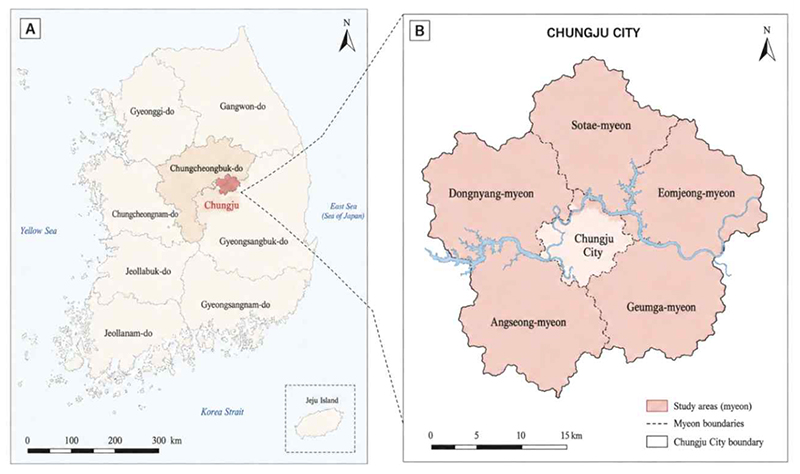
Location of Chungju and the Five Study Areas Examined in This Study: Geumga-myeon, Dongnyang-myeon, Sotae-myeon, Angseong-myeon and Eomjeong-myeon
3.3 Data sources
The study draws on five categories of data: field inventory records, documentary sources, epigraphic materials, visual records and spatial information. The principal empirical source is the author-compiled inventory Non-designated Cultural Heritage of Chungju: Dongnyang-myeon, Sotae-myeon, Geumga-myeon, Angseong-myeon and Eomjeong-myeon (Eo, Noh, and Kim 2024). The inventory records site name, classification, material, location, geographic coordinates, access route, date or period, dimensions, historical background, present condition and photographs.
Documentary analysis was used to contextualise the field inventory. Bowen (2009) defines document analysis as a systematic procedure for reviewing and interpreting documents in qualitative research. In this study, documentary sources were used to interpret site histories, names, dates, historical figures, lineages, commemorative practices and local meanings. These sources include local gazetteers, literary collections, genealogical materials, epigraphic records and previously published local cultural heritage documentation where available.
Epigraphic materials were treated as a particularly important form of evidence. Tombstones, commemorative steles, pavilion plaques, shrine records and foundation inscriptions provide information on names, dates, titles, kinship relations, commemorative intentions and restoration histories. However, such texts were not treated as transparent historical facts. They were analysed as heritage inscriptions: material texts that shape how a site is attributed, remembered and legitimised. This approach follows value-based heritage research, which recognises that heritage significance is produced through multiple forms of evidence, interpretation and social use (Mason 2002; Fredheim and Khalaf 2016).
Visual and spatial data were also central to the analysis. Field photographs were used to examine site condition, material form, surrounding landscape, access, visibility, maintenance and signs of deterioration. Location data and route descriptions were used to interpret how sites are embedded in rivers, hills, village edges, ancestral burial grounds, roads and former settlement areas. This visual-spatial analysis was necessary because many non-designated heritage sites cannot be understood adequately as isolated objects. Their meaning often depends on their relationship to landscape, route, view, ritual access and settlement history.

Data Sources and Analytical Use
3.4 Case selection and analytical sampling
The study does not discuss every recorded site in equal detail. Instead, it uses purposive sampling to select representative and analytically rich cases from the wider inventory. This strategy is consistent with qualitative case-study research, in which cases are selected for their capacity to illuminate a theoretical issue rather than to represent a population statistically (Stake 1995; Yin 2018).
The selected cases were chosen according to four criteria. First, the site had to be non-designated or discussed in the inventory as part of Chungju’s non-designated heritage field. Second, it had to show a clear relationship between material remains and local cultural landscape. Third, it had to reveal one or more of the study’s analytical dimensions: landscape, ritual practice, memory, custodianship, recognition or fragility. Fourth, the case had to offer evidence of continuity, transformation, vulnerability or loss.
The analysis gives particular attention to four groups of cases. The first group consists of Confucian and lineage heritage, including seowon, shrines, pavilions and ancestral sites. These cases reveal how scholarship, ritual and kinship are spatially anchored. The second group consists of funerary and commemorative heritage, including tombs, tombstones and steles. These sites are important for analysing how local elites, descendants and historical figures are remembered through landscape and inscription. The third group consists of village and ritual heritage, including communal ritual sites and shrine-related practices. These cases show how intangible practices activate material places. The fourth group consists of fragile or disappearing heritage, including sites that are difficult to locate, poorly maintained, physically altered or remembered only through partial local accounts.
This sampling strategy allowed comparison across different modes of survival and vulnerability. For example, a well-maintained lineage tomb could be compared with a difficult-to-identify tomb whose attribution depended on local recollection. A restored pavilion could be compared with a memorial structure whose earlier form had disappeared. A village ritual site could be compared with a commemorative stele whose meaning depended primarily on inscriptional legibility. Such comparisons helped identify the conditions under which non-designated heritage remains visible, becomes fragile or disappears.
3.5 Analytical framework and coding procedure
The analysis is structured by a relational cultural landscape framework. The framework builds on the landscape–ritual–memory approach introduced in the study, but it specifies six analytical dimensions in order to maintain consistency between the coding table and the conceptual model: landscape, ritual practice, memory, custodianship, recognition/protection and fragility.
“Landscape” refers to the spatial embeddedness of heritage in topography, rivers, hills, village boundaries, settlement patterns, burial grounds, roads, views and access routes. “Ritual practice” refers to repeated acts that activate or sustain heritage, including ancestral rites, shrine rituals, commemorative visits, seasonal practices and village ceremonies. “Memory” refers to the narrative, inscriptional and symbolic dimensions through which sites are connected to historical persons, events, genealogies, oral accounts and local identity. “Custodianship” refers to the actors and practices of care, including descendants, lineage associations, village residents, local historians, cultural organisations and municipal actors. “Recognition/protection” refers to the formal, local and documentary visibility that shapes whether a site is supported or neglected. “Fragility” refers to the conditions under which a site becomes materially, mnemonically, ritually, custodially or institutionally vulnerable.
Coding was conducted in two stages. The first stage involved descriptive coding of each selected site according to heritage type, location, material form, period, documentary evidence, present condition and known custodianship. The second stage involved interpretive coding according to the six analytical dimensions. Saldaña (2021) notes that qualitative coding moves from descriptive organisation to interpretive pattern recognition. Following this principle, the analysis first organised the empirical material and then identified cross-case patterns.
Analytical Coding Framework
The coding process was comparative. Individual sites were first analysed on their own terms and then compared across type and location. The comparison did not aim to rank sites by importance. Rather, it examined how different combinations of landscape, ritual practice, memory, custodianship and recognition produced different degrees of continuity or fragility.
Figure 2 visualises this framework. It presents non-designated heritage as a local cultural landscape produced through the interaction of spatial setting, ritual activation, memory and custodianship, while also showing how weak recognition or disrupted care can generate fragility.
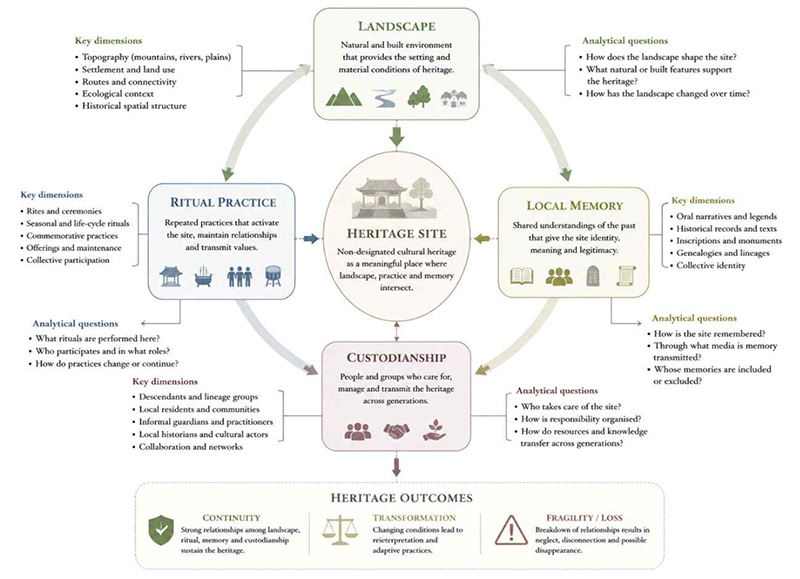
Relational Framework for Analysing Non-Designated Heritage as Local Cultural Landscape. (Figure created by the author using a generative AI tool (ChatGPT 5.3))
Because non-designated heritage often lacks a single authoritative record, triangulation was essential. The study compared field descriptions, photographs, location data, inscriptions, historical documents and local contextual accounts wherever possible. Triangulation did not eliminate ambiguity, but it allowed the analysis to distinguish between well-supported claims, plausible interpretations and uncertain attributions.
A site with a surviving inscription, recorded coordinates, documented dimensions and visible material remains was treated as a stronger evidentiary case than a site known mainly through local recollection. However, uncertain cases were not excluded automatically. In the study of non-designated heritage, uncertainty itself can be analytically significant. The difficulty of locating a tomb, the absence of a stele or the weakening of local knowledge may reveal how heritage memory becomes fragile.
The study therefore adopts an evidentiary hierarchy without reducing heritage to documentary certainty alone. Material remains, written texts, visual records and local contextual information were considered together, but each was evaluated according to its reliability and interpretive limits. This approach is consistent with heritage value research, which recognises that heritage significance is constructed from multiple kinds of evidence and that value assessment necessarily involves interpretation (Mason 2002; Fredheim and Khalaf 2016).
3.6 Reflexivity, ethics and limitations
This research is based on publicly visible heritage sites and published or author-compiled documentation. It does not use private personal information or individually identifiable interview data. Local accounts appearing in the field inventory were treated as contextual evidence rather than as formal interview transcripts. Where attribution was uncertain, the analysis avoids presenting local claims as verified historical fact.
Reflexivity is important because the category of “non-designated heritage” is not neutral. It is produced through the relationship between state designation systems, local documentation practices, expert categories and community recognition. The study therefore does not assume that all non-designated sites should become formally designated. Nor does it treat formal designation as irrelevant. Instead, it examines how different degrees of recognition shape visibility, vulnerability and custodianship.
The study has three limitations. First, it focuses on Chungju and does not claim to represent all Korean local heritage or all forms of non-designated heritage internationally. Second, because the analysis relies primarily on field inventory and documentary evidence, it does not fully capture the perspectives of all residents, descendants, landowners or local officials. Future research should include interviews, participatory mapping and comparative work in other national contexts. Third, heritage status and site condition can change over time. A site documented as non-designated in the inventory may later be registered, restored, relocated or lost.
Despite these limitations, the methodology is appropriate for the study’s aim. By combining field documentation, document analysis, inscriptional evidence, visual-spatial interpretation and comparative thematic coding, the study shows how non-designated heritage operates as a local cultural landscape. This methodological approach allows the study to move beyond the question of whether individual sites deserve official designation and instead examine how heritage value is made, sustained and endangered through situated relationships among place, practice, memory and care.
4. Chungju’s Non-Designated Heritage as Local Cultural Landscape
4.1 Spatial distribution and landscape patterning
Chungju’s non-designated heritage is best understood as a dispersed local cultural landscape rather than as a collection of isolated historical remains. The sites recorded in the field inventory are distributed across rural settlements, riverine routes, low hills, ancestral burial grounds, shrine compounds, former temple locations, village entrances and roadside spaces. In total, the inventory records 106 non-designated heritage sites across five township-level areas: twenty-one in Geumga-myeon, twenty-two in Dongnyang-myeon, twenty-eight in Sotae-myeon, fourteen in Angseong-myeon and twenty-one in Eomjeong-myeon (Eo, Noh, and Kim 2024).
This distribution is significant for two reasons. First, it shows that non-designated heritage in Chungju is not marginal in spatial extent. It forms a dense and regionally differentiated landscape of local memory. Second, the sites are organised through cultural and geographical relations rather than through a single administrative or monumental centre. The relevant scales are the river port, the village, the hillside, the lineage burial ground, the ritual route and the township-level locality. This supports the geographical view that heritage is produced through spatial relations, territorial attachments and socially meaningful landscapes (Graham, Ashworth, and Tunbridge 2000; Ingold 1993).
The recorded sites include Confucian academy-shrine complexes, pavilions, lineage shrines, tombs, tombstones, commemorative steles, filial and loyalist memorials, village ritual spaces, rock inscriptions and royal placenta chamber remains. These types of heritage do not share a single material form. Their shared feature is that they connect place to memory and practice. A tomb becomes meaningful through its location within a lineage burial landscape; a pavilion through its relation to a scenic view, literary memory or riverside route; a village shrine through its continued ritual use; and a stele through the inscriptions that stabilise names, dates, moral values and historical attribution.
The typological range summarised in Table 3 indicates that Chungju’s non-designated heritage is not a minor remainder of the official heritage system. It constitutes a layered cultural landscape in which Confucian memory, lineage territory, village ritual, riverine mobility, commemorative practice and local historical knowledge intersect.
Spatial and Thematic Distribution of Chungju’s Non-Designated Heritage
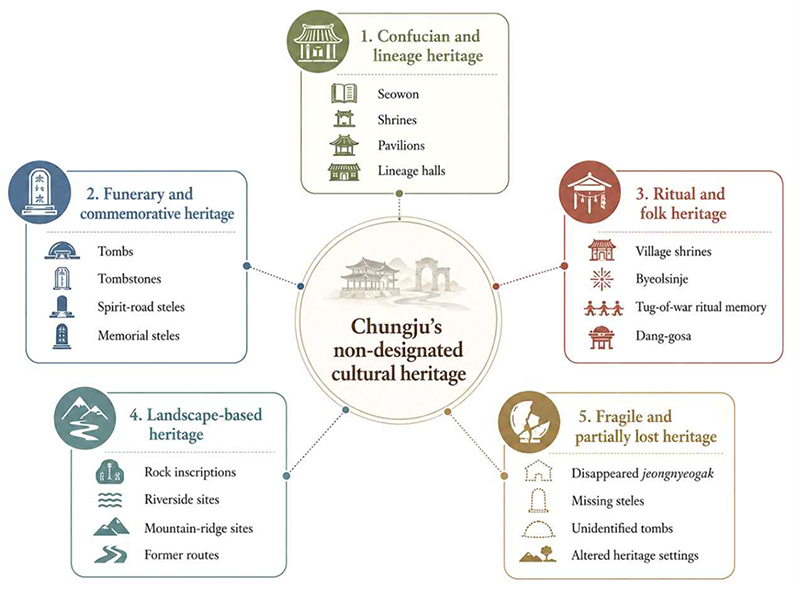
Typological Structure of Non-Designated Cultural Heritage in Chungju.(Figure created by the author using a generative AI tool (ChatGPT 5.3))
4.2 Confucian and lineage landscapes
One of the most distinctive features of Chungju’s non-designated heritage is the prominence of Confucian and lineage-related sites. These include seowon, shrines, memorial pavilions, ancestral tombs, tombstones, spirit-road steles, filial pavilions and lineage memorial halls. A seowon is a Confucian academy-shrine complex that historically combined scholarly learning, commemoration and ritual veneration. Such sites are especially visible in Geumga-myeon, Dongnyang-myeon and Sotae-myeon, where local heritage is organised around scholars, officials, clan ancestors and burial geographies.
Geumga-myeon provides a clear example of how Confucian memory becomes spatially organised. The recorded sites include Hadam-ri Mohyeonjeong, Hagang Seowon dedicated to Hong I-sang, the tomb of Hong Ok-bo, several tombs and tombstones of Pungsan Hong lineage figures, lineage shrines and groups of commemorative steles (Eo, Noh, and Kim 2024). Hagang Seowon was founded in 1786 to honour Hong I-sang, abolished during the nineteenth-century suppression of seowon, re-established as an altar in 1907 and reconstructed in 1974. Mohyeonjeong, located on a nearby hill and associated with the memory of Sahujeong pavilion, connects Joseon-period Confucian literati memory, descendant-led reconstruction and riverside landscape.
The significance of these sites is distributed across several elements: the burial mound, the stele, the inscription, the hill or river setting, the approach route, the ritual calendar and the continuing responsibility of descendants. Jones (2017) argues that the social value of heritage is formed through attachment, identity, memory and practice rather than through expert assessment alone. Chungju’s lineage sites illustrate this point. Their value is not captured adequately by architectural rarity or material condition alone. It emerges through social-spatial relations among descent, ritual obligation, local status, moral commemoration and landscape setting.
Dongnyang-myeon and Sotae-myeon show related but distinct lineage landscapes. Dongnyang-myeon’s recorded sites are concentrated around Hacheon-ri and Daejeon-ri, with numerous tombs and steles associated with figures such as Yi Yu-yang, Gwon Don-in, Park Jae, Gwon Sang-ha, Yi Gi-jin, Hong Bong-sang and Yi Geuk-gam. Sotae-myeon contains a ridge-based distribution of lineage memory. Oryang-ri is associated with the Heo lineage, including Heo Jam, Heo Gam, Heo Gyeong and Heo Jeok, while Yangchon-ri and Songgok are associated with the Yeoheung Min lineage, including Min Eung-geon, Min Yong and Min Ham (Eo, Noh, and Kim 2024).
These examples show that lineage heritage in Chungju is spatially patterned. Tombs, shrines and steles do more than commemorate individuals. They define relational geographies of descent, scholarly authority and local identity. When a stele disappears, a tomb owner is forgotten or ritual management ceases, the loss affects more than a single object. It weakens the spatial and social infrastructure through which the landscape remains legible as heritage.
4.3 Riverine, hillside and village settings
Chungju’s non-designated heritage is shaped by riverine and mountainous settings. The Namhan River, tributary routes, low mountain ridges and village-edge hills structure how sites were built, approached, remembered and sometimes forgotten. These settings are especially important in Geumga-myeon, Dongnyang-myeon, Sotae-myeon and Eomjeong-myeon.
In Geumga-myeon, the route from Chungju across the river toward Hadam-ri situates Mohyeonjeong and Hagang Seowon within a riverside scholarly landscape. The field inventory records that the seowon and pavilion are approached through local roads connected to the river-crossing area and that Mohyeonjeong stands on a hill from which the Namhan River can be seen (Eo, Noh, and Kim 2024). The pavilion’s value is inseparable from this setting. It combines scenic appreciation, Confucian literary memory, commemorative reconstruction and riverine atmosphere. The case also shows how landscape-dependent heritage can become vulnerable: later stone-wall construction affected water flow and contributed to slope damage near Mohyeonjeong, requiring remedial intervention.
Dongnyang-myeon presents a different relationship between heritage and landscape. Its heritage is concentrated in areas shaped by hills, valleys and the historical impact of the Chungju multipurpose dam. The inventory notes that dam construction submerged villages and cultural assets, including sites associated with Jeongtosa Temple. It also records that some residents moved to higher hillside locations because they could not fully leave their ancestral ground (Eo, Noh, and Kim 2024). For non-specialist readers, this attachment to ancestral ground requires cultural explanation. In Korean lineage contexts, ancestral graves and long-inhabited settlement land are closely tied to descent identity, ritual obligation and family memory. Relocation therefore involves more than a change of residence; it can disrupt the spatial basis of remembrance.
Sotae-myeon demonstrates the importance of ridges, remoteness and partial local knowledge. Oryang-ri and Yangchon-ri are not merely administrative units. They are topographical memory zones linked to different lineages, burial grounds and ritual sites. The case of Yi Myeon-seung’s tomb illustrates this condition. The site was remembered locally as a daegammyo, literally a “high official’s tomb,” but lacked a clear stele. Its identification therefore depended on partial local recollection and residual material traces. This case shows how landscape memory can become unstable when inscriptional evidence and active custodianship weaken.
Eomjeong-myeon adds a river-port and folk-ritual dimension. Mokgye was historically a river-port settlement associated with transport, markets and communal ritual life along the Namhan River. The Mokgye tug-of-war and Byeolsinje origin stele commemorates this riverine history. Here, byeolsinje refers to a communal tutelary ritual associated with village protection, seasonal renewal and local guardian beings. The site links river transport, trade, ritual performance and village identity, showing that Chungju’s non-designated heritage includes both elite Confucian memory and folk ritual landscapes.
Taken together, these examples show that Chungju’s non-designated heritage operates through landscape relations. Routes, views, slopes, water edges, village boundaries and ritual pathways are not secondary background features. They are the spatial conditions through which heritage becomes meaningful and through which it may also become vulnerable.
4.4 Uneven recognition and landscape vulnerability
The density of non-designated heritage in Chungju does not lead to uniform recognition or preservation. Some sites are actively maintained by descendants, lineage associations, residents, schools or local offices. Others are physically deteriorated, difficult to locate, partially erased or dependent on weak local recollection. This unevenness is one of the key findings of the case. It shows that the survival of non-designated heritage depends on the availability of custodianship, visibility, access, documentary support and local recognition.
Geumga-myeon includes several well-maintained lineage sites, particularly tombs and shrines cared for by descendants. Yet the Mohyeonjeong case shows that even locally recognised heritage can be threatened when surrounding landscape management is not integrated into heritage care. In this case, alteration to the site’s setting affected the slope and required intervention. The issue was not only the condition of the pavilion itself, but the relationship between the pavilion and its landscape.
Dongnyang-myeon shows how state-led infrastructural transformation can create heritage vulnerability. Dam construction submerged villages and cultural traces, while surviving sites on higher ground became anchors of continuity in a changed landscape. These sites can be read as remnants of displacement and resettlement, where memory persists through relocated communities, descendant recognition and surviving material markers.
Sotae-myeon reveals the vulnerability of weakened memory. The search for Yi Myeon-seung’s tomb shows how a site can remain physically present but become uncertain in meaning. Without a surviving inscription and with only partial local knowledge, the tomb becomes difficult to identify with confidence. Such cases demonstrate that heritage loss often occurs gradually through small breaks in transmission: a missing stele, an overgrown path, a forgotten name or the disappearance of people who remember the site.
Angseong-myeon provides one of the clearest examples of loss outside formal protection. The inventory records the disappearance of the jeongryeogak associated with Jo Ung, a loyalist figure commemorated in local memory. A jeongryeogak is a commemorative pavilion or shrine-like structure erected to honour exemplary loyalty, filial piety or chastity within a Confucian moral order. The structure was reportedly removed after a change in landownership and delayed administrative response (Eo, Noh, and Kim 2024). This case illustrates how weak formal recognition can increase the vulnerability of locally meaningful heritage.
Eomjeong-myeon combines historical density with visible fragility. The area contains folk ritual sites, river-port memory, rock inscriptions, tombs of military and independence-related figures, shrine sites and the Judong placenta chamber stele. The inventory notes that one of two placenta chamber steles had disappeared and that the remaining stele stood in a diminished landscape altered by later burial-ground use (Eo, Noh, and Kim 2024). This example shows how a site may remain materially visible while losing interpretive coherence.
These patterns suggest that non-designated heritage cannot be assessed only through a binary distinction between designated and undesignated status. Some non-designated sites are actively cared for and locally meaningful; others are close to disappearance. Some sites have strong material remains but weak memory; others have strong ritual recognition but limited documentary visibility. Heritage value is therefore better understood as a configuration of material, social, historical, spatial and affective relationships (Fredheim and Khalaf 2016).
4.5 Interpreting Chungju’s local cultural landscape
Chungju’s non-designated heritage reveals three broader patterns. First, heritage is spatially relational. Sites are embedded in village locations, hillside tombscapes, river-port routes, shrine compounds, school grounds, former temple sites and ritual places. Their meanings emerge from their position within these local cultural landscapes.
Second, heritage is socially sustained. Its survival often depends on descendants, lineage groups, residents, schools, municipal offices or local historians. Where custodianship persists, sites remain legible and cared for even without formal designation. Where custodianship weakens, historically meaningful sites may become vulnerable.
Third, heritage is mnemonically fragile. Its value depends on the continuity of names, stories, inscriptions, rituals and local knowledge. When these connections are interrupted, a site may remain physically present but become difficult to interpret. The threat to non-designated heritage is therefore not limited to material destruction. It also includes the erosion of the relationships that allow a place to be remembered.
This section has shown that Chungju’s non-designated heritage is a local cultural landscape produced through the interaction of spatial setting, ritual practice, memory and custodianship. The Chungju case does not suggest that lineage-based and ancestral-ritual mechanisms are universal. Rather, it demonstrates why non-designated heritage should be examined through locally specific relationships among place, practice, memory and care. In this sense, the case contributes to social and cultural geography by showing how ordinary regional landscapes can carry dense forms of heritage value beyond formal designation.
5. Ritual Practice, Custodianship and Everyday Care
5.1 Lineage-based custodianship and ancestral landscapes
The non-designated heritage of Chungju shows that local cultural landscapes are sustained through practices of care as much as through material survival. In many cases, the primary custodians of these sites are descendants, lineage associations and local kinship groups rather than state agencies or professional conservation bodies. Their work includes conducting ancestral rites, maintaining tombs and shrines, repairing pavilions, preserving inscriptions, clearing access routes and transmitting genealogical knowledge. These practices are central to how heritage remains visible and meaningful outside formal designation.
This pattern is especially strong in Confucian and lineage-related sites. Korean ancestor worship has long been connected to kinship organisation, social hierarchy, genealogical consciousness and spatially embedded ritual practice (Janelli and Janelli 1982). Deuchler (1992) shows that the Confucian transformation of Chosŏn Korea reshaped family and lineage institutions, making ancestral commemoration an important mechanism of social order. In Chungju, this historical background helps explain why tombs, seowon, lineage shrines, pavilions and commemorative steles remain socially meaningful even when they are not officially designated heritage.
Hagang Seowon in Geumga-myeon is a key example. A seowon is a Confucian academy-shrine complex that historically combined learning, scholarly commemoration and ritual veneration. Hagang Seowon was founded in 1786 to honour Hong I-sang, abolished during the nineteenth-century suppression of seowon, re-established as an altar in 1907 and reconstructed in 1974. The field inventory records that the site was established and maintained by the Pungsan Hong lineage and enshrines Hong I-sang alone (Eo, Noh, and Kim 2024). Its significance lies in the continuing connection among lineage memory, scholarly commemoration, ritual practice and local landscape.
Mohyeonjeong, located near Hagang Seowon, further illustrates how lineage custodianship materialises memory in place. The pavilion was built in 1937 by local Confucian scholars and descendants of Hong I-sang to commemorate earlier scholarly traces associated with Sahujeong pavilion. It was later repaired and maintained. Its value is produced through the relationship between literary memory, descendant-led reconstruction, riverside views and the broader Confucian landscape of Geumga-myeon. Mohyeonjeong therefore functions as both an architectural structure and a spatial expression of remembrance.
Other cases show how lineage-based care stabilises local heritage. Gyeongmosa, the Gwangsan Kim lineage shrine in Jambyeong-ri, was constructed through a lineage decision and remains connected to a ritual building behind Bochugjae (Eo, Noh, and Kim 2024). The tomb and tombstone of Hong Man-jong in Dochon-ri are described as being well maintained by descendants. Yeongmojae and the Hong Sun-geuk filial piety stele in Angseong-myeon are also recorded as carefully managed by descendants and interpreted as resources for transmitting filial ethics (Eo, Noh, and Kim 2024).
These examples show that lineage-based custodianship functions as a form of local heritage governance. It stabilises sites, maintains ritual use, preserves inscriptions, sustains attribution and keeps places legible within local memory. However, it should not be romanticised. Waterton and Smith (2010) caution that “community” should not be treated as a unified or harmonious category. Lineage custodianship can be selective, often preserving elite male genealogies, official titles, Confucian virtues and patrilineal memory more strongly than other forms of local experience. In Chungju, it is one of the most important mechanisms of survival, but it is also culturally specific and socially uneven.
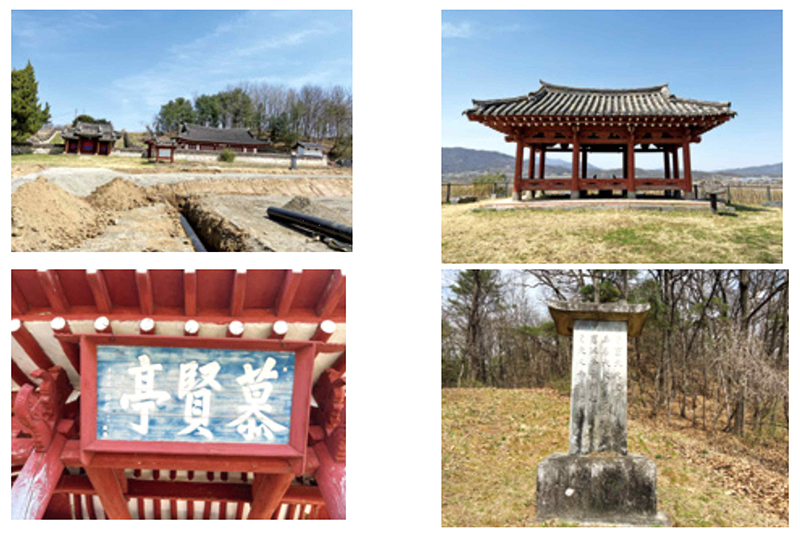
Confucian and Lineage Heritage in Chungju: Hagang Seowon, the Front View of Mohyeonjeong Pavilion, the Signboard of Mohyeonjeong, and the Tombstone of Hong Man-jong
Together, these sites illustrate how lineage-based custodianship, commemorative architecture, inscriptional memory and ritual continuity sustain non-designated cultural heritage beyond formal designation. Photographs by the author.
5.2 Ritual practice as spatial activation
Ritual practice is one of the main ways through which non-designated heritage becomes active within Chungju’s local cultural landscape. A site that continues to be visited, maintained and ritually used is more likely to remain legible as heritage. When ritual practice declines, the site may remain physically present but become socially and mnemonically unstable.
Connerton (1989) argues that societies remember through bodily and ritual practices as well as through written records. This insight is useful for interpreting Chungju’s heritage landscape. A tombstone may preserve a name, but the tomb becomes meaningful through repeated visits and ancestral rites. A shrine may retain its structure, but its significance depends on continued ritual use. A pavilion may remain standing, but its heritage value is strengthened when it continues to be connected to commemorative narratives, descendants and local interpretation.
The Chungju cases also complicate the distinction between tangible and intangible heritage. The sites are materially tangible, but their value often depends on intangible practices such as ancestral rites, filial commemoration, village rituals, oral transmission, inscription reading and local historical knowledge. UNESCO’s 2003 Convention emphasises practices, representations, knowledge and skills transmitted by communities (UNESCO 2003). Kirshenblatt-Gimblett (2004) similarly argues that intangible heritage is produced through cultural mediation and recognition. In Chungju, ritual practice does not merely preserve a pre-existing heritage object. It activates the site as a continuing social and spatial relationship.
The contrast between maintained and vulnerable sites demonstrates this point. The tomb of Hong Man-jong is recorded as well managed by descendants, suggesting that continuing kinship responsibility helps secure both the material condition and symbolic stability of the site (Eo, Noh, and Kim 2024). Yeongmojae and the Hong Sun-geuk filial piety stele are also maintained by descendants and interpreted as educational resources for filial ethics. In these cases, ritual and moral memory give the sites continuing social function.
Yi Myeon-seung’s tomb in Sotae-myeon shows a different condition. The site was remembered locally as a daegammyo, literally a “high official’s tomb,” but it lacked a clear stele and depended on partial local recollection (Eo, Noh, and Kim 2024). The problem here is not only physical preservation. It is the weakening of the chain that links place, name, inscription and memory. Without inscriptional evidence and active custodianship, the site becomes difficult to interpret as heritage.
The disappearance of the jeongryeogak associated with Jo Ung in Angseong-myeon offers a sharper example. A jeongryeogak is a commemorative pavilion or shrine-like structure erected to honour exemplary loyalty, filial piety or chastity within a Confucian moral order. The inventory records that the memorial structure associated with Jo Ung was removed after a change in landownership and delayed administrative response (Eo, Noh, and Kim 2024). This case illustrates that historical significance alone does not secure heritage survival when ritual practice, custodianship and institutional protection are weak.
Ritual continuity therefore works as a form of spatial activation. It keeps a site within the field of local memory and care. Yet it is not a substitute for legal or administrative support. Ritual can sustain meaning, but it cannot always prevent removal, neglect or landscape alteration. This is why non-designated heritage requires both support for living practice and mechanisms for documenting sites whose ritual connections are weakening.
5.3 Everyday maintenance and informal conservation
Much of Chungju’s non-designated heritage survives through informal conservation. This refers to everyday practices of care carried out by descendants, residents, village groups, local historians, schools and other local actors outside professional conservation systems. Such practices may include cleaning, repairing, repainting, clearing paths, protecting inscriptions, maintaining ritual objects, recording local histories and guiding others to difficult-to-find sites.
Byrne (2008) argues that heritage should be understood as social action. This perspective is important because many non-designated sites are not simply unmanaged. They are managed through local norms, kinship responsibility, village funds, voluntary labour, ritual obligation and historical attachment. These forms of care may be modest, but they prevent sites from becoming invisible or unintelligible.
Hong Ok-bo’s tomb illustrates this everyday dimension of conservation. The field inventory records that descendants living elsewhere could not regularly care for the tomb, while collateral descendants living nearby carried out maintenance and preserved its present condition (Eo, Noh, and Kim 2024). This form of care does not amount to professional restoration, but it keeps the site within the sphere of local recognition.
Mokgye Byeolsinje and the Buheungdang shrine ritual in Eomjeong-myeon expand the discussion beyond lineage heritage. Byeolsinje refers to a communal tutelary ritual associated with village protection, seasonal renewal and local guardian beings. The Buheungdang ritual is linked to village belief, riverine history and communal practice. The inventory records ritual funding through the village community, offerings and the movement of ritual participants to the shrine (Eo, Noh, and Kim 2024). In this case, informal conservation includes the maintenance of a ritual ecology, not only the care of a structure.
This everyday care is an important part of Chungju’s cultural landscape. It shows that heritage value is produced through repeated local labour and practical knowledge. At the same time, informal conservation has clear limits. It may lack stable funding, technical expertise, legal authority and long-term continuity. It may depend on ageing descendants or a small number of local actors. It may preserve certain memories while leaving others marginal. Crooke (2010) notes that community heritage involves questions of motivation, authority and control; those questions are equally relevant to Chungju’s non-designated heritage.
5.4 Custodianship, selectivity and the limits of local care
The Chungju case shows that custodianship is a powerful but uneven mechanism of heritage survival. Ancestral rites are especially significant for lineage-based tombs, shrines, seowon and commemorative steles. They create a recurring relationship between descendants and place, linking material remains to genealogical memory and moral obligation. For this reason, ancestral rites are one of the strongest forms of custodianship identified in this study.
However, ancestral rites do not explain all forms of non-designated heritage in Chungju. Village ritual sites, river-port memorials, rock inscriptions, school-related monuments and local commemorative steles depend on different forms of care. Some are sustained by communal ritual practice; others by inscriptional legibility, local historical writing, municipal attention or everyday recognition by residents. The relative importance of custodianship therefore varies by site type. Lineage tombs rely strongly on descendants, village ritual sites on communal participation, and steles or rock inscriptions on documentation, visibility and landscape context.
This distinction is important for the study’s wider argument. The Chungju case does not suggest that lineage-based custodianship and ancestral rites are universal mechanisms of heritage survival. Rather, it shows how locally specific forms of care produce and maintain cultural landscapes under conditions of weak formal protection. In other cultural contexts, comparable functions may be performed by religious communities, neighbourhood associations, Indigenous custodians, civic groups or heritage volunteers. The general issue is not the specific form of Korean lineage practice, but the relationship among place, memory, care and recognition.
For heritage policy, this means that support for non-designated heritage should begin before a site qualifies for formal designation. Local governments and heritage institutions can strengthen everyday care through documentation, inscription recording, small-scale repair advice, vegetation management, digital mapping, emergency response and educational interpretation. Such support should not replace local custodianship. It should reduce the vulnerability of sites whose survival currently depends on fragile and uneven networks of care.
Taken together, lineage-based custodianship, ritual practice and everyday maintenance show that non-designated heritage survives through relationships rather than status alone. In Chungju, heritage is kept active through remembering, visiting, maintaining and ritually reactivating places. These practices sustain local cultural landscapes, but they can also disappear. Understanding this tension is essential for analysing non-designated heritage as a living yet vulnerable form of place-based memory.
6. Memory, Loss and Relational Fragility
6.1 Place-based memory and unstable attribution
Chungju’s non-designated heritage sites are not only material remains distributed across rural landscapes. They are also place-based mnemonic devices through which descendants, residents and local cultural mediators connect historical figures, moral values and community narratives to specific locations. Tombs, steles, pavilions, shrines, rock inscriptions and commemorative structures make memory spatially encounterable. They allow local history to be approached through hillsides, river routes, village edges, burial grounds and ritual paths.
This relationship partly resonates with Nora’s (1989) attention to the attachment of memory to places, objects and rituals. However, the Chungju cases differ from monumental national lieux de mémoire. They are modest, dispersed and often dependent on fragile chains of attribution. Their mnemonic force is sustained through a combination of material traces, inscriptions, ritual practice, local knowledge and custodianship. When one of these supports weakens, a site may remain physically present but become difficult to interpret as heritage.
The search for Yi Myeon-seung’s tomb in Sotae-myeon illustrates this condition. The site was remembered locally as a daegammyo, literally a “high official’s tomb,” but it lacked a clear stele. Its identification therefore depended on partial local recollection, family association and residual material traces (Eo, Noh, and Kim 2024). The significance of this case lies not only in the uncertainty of attribution. It shows how local heritage memory can persist in fragmentary form while also becoming vulnerable when inscriptional, ritual and custodial supports are weak.
Ryu Je-ham’s tomb in Eomjeong-myeon shows another form of unstable recognition. Ryu Je-ham was the son of Ryu In-seok, an anti-colonial guerrilla leader associated with resistance to Japanese imperial rule. Despite this historically significant lineage, the grave is described as modest and poorly recognised in the local heritage record (Eo, Noh, and Kim 2024). The case shows that historical significance does not automatically produce heritage visibility. A site may preserve an important memory in documentary or inscriptional form, yet remain weakly recognised in the landscape.
These examples suggest that local heritage can be lost even before physical disappearance occurs. A name may become uncertain, a stele may disappear, descendants may move away, inscriptions may become unreadable or local knowledge may no longer be transmitted. Memory loss is therefore material, spatial and epistemic. It concerns the weakening of the knowledge required to recognise a place as heritage.
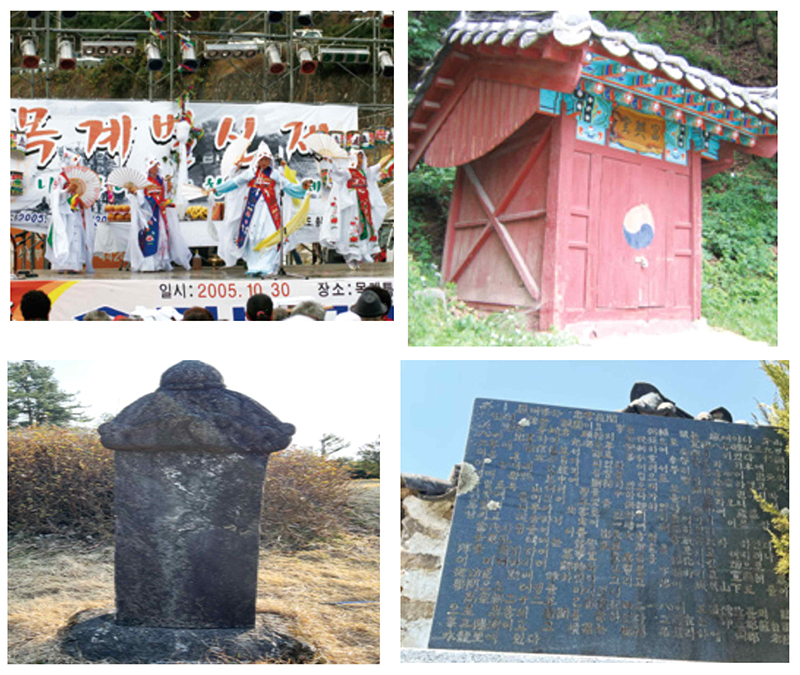
Ritual Practice and Fragile Memory in Chungju’s Non-Designated Heritage: Mokgye Byeolsinje Ritual Site, the Former Buheungdang Shrine, the Placenta Chamber Stele of Prince Nakseon at Judong, and the Explanatory Stele of Yi Seong-guk Jeongnyeogak
These cases show how ritual practice, local custodianship and inscriptional memory sustain heritage while also exposing its vulnerability outside formal designation. Photographs by the author.
6.2 Disappearance outside formal protection
The most direct form of fragility appears when non-designated heritage is physically altered, removed or allowed to decay because it lacks effective protection. The disappearance of the jeongryeogak associated with Jo Ung in Angseong-myeon is a key example. A jeongryeogak is a commemorative pavilion or shrine-like structure erected to honour exemplary loyalty, filial piety or chastity within a Confucian moral order. The structure associated with Jo Ung reportedly disappeared after a change in landownership and delayed administrative response (Eo, Noh, and Kim 2024).
This case is important because the issue is not the absence of historical meaning. Jo Ung was a commemorated loyalist figure, and the site had local significance. The problem was the absence of effective protection and timely intervention. The case shows how a culturally meaningful site can disappear when it falls outside the legal and administrative security attached to formal designation.
The Gachun-ri placenta chamber stele in Eomjeong-myeon presents a different but related case. Royal placenta chamber sites are associated with the burial or enshrinement of royal placentas, a practice historically linked to royal birth, auspicious geography and dynastic legitimacy. The field record notes that one of the two steles at the site had disappeared, while the remaining stele stood in a landscape diminished by later burial-ground use (Eo, Noh, and Kim 2024). Here, loss is incremental rather than sudden. One element disappears, the surrounding context changes, interpretive clarity weakens and the remaining object becomes increasingly separated from its original spatial meaning.
These cases show that disappearance outside designation is rarely a purely physical event. It involves changes in ownership, administrative attention, landscape context, documentation and public recognition. DeSilvey (2006) reminds us that material change and decay can sometimes become part of how places tell stories. Yet the Chungju cases also require caution. Preventable loss should not be romanticised as productive decay. Holtorf (2015) warns against treating all heritage loss in the same way. In Chungju, loss must be understood in relation to power, care, recognition and institutional capacity.
6.3 Politics of recognition
Non-designated heritage is shaped by multiple forms of recognition. Recognition does not refer only to formal designation by the state. It also includes local recognition, lineage recognition, ritual recognition, documentary recognition and scholarly recognition. A site may be recognised by descendants but absent from municipal heritage registers. It may be recorded by local historians but not interpreted for the wider public. It may have strong ritual meaning but limited architectural visibility. It may remain materially intact while becoming socially forgotten.
This layered condition is central to Chungju’s non-designated heritage. Jones (2017) argues that the social value of heritage is often difficult to capture through formal assessment because it is produced through attachment, identity, belonging and lived relationships. The Chungju cases support this argument. A tomb, shrine, pavilion or stele may have limited visual prominence, yet carry deep social value for descendants, village residents or local historians. Conversely, a site may have historical importance but lose social value when custodianship and memory weaken.
Waterton and Smith (2010) caution that community heritage should not be treated as a simple expression of unified community identity. This point is important for Chungju. Lineage-based heritage often preserves elite male genealogies, Confucian moral narratives and patrilineal memory more clearly than other forms of local experience. Folk ritual sites and river-port memories, such as those associated with Mokgye, broaden the heritage field beyond lineage memory, but they too depend on collective participation and ritual continuity.
Recognition therefore operates across several levels. At the state level, formal designation determines legal protection and administrative responsibility. At the local level, residents, descendants and cultural mediators determine whether a site remains meaningful in everyday life. At the material level, inscriptions, plaques and steles stabilise attribution. At the ritual level, repeated practice keeps memory active. Non-designated heritage becomes fragile when these levels no longer reinforce one another.
6.4 Relational forms of fragility
The Chungju case suggests that fragility should be understood relationally. A site is fragile not only because its material fabric is damaged. It is fragile when the relationships that sustain it are weakened. These relationships include the connection between a site and its landscape, between a tomb and its descendants, between a shrine and its ritual calendar, between a stele and its interpreters, and between local knowledge and public documentation.
This relational understanding helps explain why some non-designated sites survive while others disappear. Sites with active custodianship, legible inscriptions, accessible routes, continuing ritual practice and local recognition tend to remain more stable. Sites with absent descendants, missing inscriptions, uncertain names, altered landscapes and weak institutional attention become vulnerable. The difference lies not only in physical condition but in the strength of the heritage relations surrounding the site.
Relational Forms of Fragility in Chungju’s Non-Designated Heritage
This typology shows that the vulnerability of local heritage is not only a conservation problem. It is also a problem of memory, practice, recognition and spatial context. Recording physical condition is necessary, but insufficient. Documentation of non-designated heritage should also record custodianship, ritual practice, local narratives, routes, landscape relations, inscriptional evidence and risks of memory loss.
6.5 From loss to landscape-sensitive documentation
The analysis of fragility points to the need for landscape-sensitive documentation. Many heritage inventories record the name, location, material form and condition of a site. These elements are important, but they do not fully capture how non-designated heritage survives. In Chungju, a site’s meaning often depends on the relationship between material remains and surrounding landscape, ritual access, custodianship, inscriptional legibility and local knowledge. A documentation system that records only the object may miss the relations that make the object meaningful.
Landscape-sensitive documentation would therefore include several additional elements. It should identify the site’s relation to rivers, hills, villages, roads, burial grounds, former settlements and ritual routes. It should record whether the site is maintained by descendants, village residents, local organisations or public institutions. It should document inscriptions, plaques and oral attributions before they disappear. It should also assess risks generated by landownership change, vegetation, altered access, infrastructure, redevelopment and the ageing of custodial communities.
Such documentation would not turn every non-designated site into formally designated heritage. Nor should it assume that all sites require the same level of intervention. Rather, it would make visible the different forms of value and vulnerability that exist below the threshold of official designation. This is especially important for sites that are materially modest but socially meaningful, or for sites whose significance depends on ritual and memory rather than architectural distinction.
Figure 6 summarises this relational understanding of fragility. It presents non-designated heritage as vulnerable when custodianship weakens, memory becomes unstable, ritual practice declines, landscape relations are altered and institutional support remains limited.
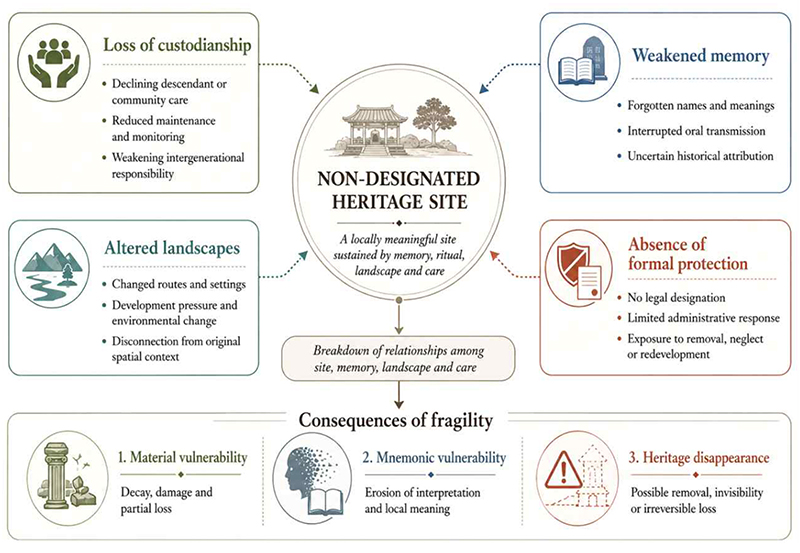
Relational Fragility of Non-Designated Heritage: Material, Mnemonic, Ritual, Custodial, Landscape and Institutional Vulnerability. (Figure created by the author using a generative AI tool (ChatGPT 5.3))
The Chungju case therefore reframes loss as a relational process. Heritage disappears not only when a structure is removed or a stele is damaged. It also disappears when names are forgotten, routes are blocked, rituals cease, inscriptions become unreadable, descendants are no longer present and local records fail to circulate. Understanding this process is essential for analysing non-designated heritage as a local cultural landscape. It shows that heritage survival depends on the continued interaction of place, memory, practice, care and recognition.
7. Discussion: Reframing Non-Designated Heritage as Local Cultural Landscape
7.1 From heritage status to landscape relations
The Chungju case shifts the discussion of non-designated heritage from the question of formal status to the question of landscape relations. Official designation remains important because it provides legal recognition, administrative responsibility and access to conservation resources. However, the absence of designation does not mean that a site lacks heritage value. The cases examined in this study show that many non-designated sites continue to organise local relationships with the past through spatial setting, ritual practice, memory and custodianship.
This finding is consistent with critical heritage scholarship, especially Smith’s (2006) concept of the authorised heritage discourse, which identifies how institutional heritage practices privilege particular forms of expert knowledge, materiality and national significance. Pendlebury (2013) similarly shows that conservation planning does not simply protect pre-existing values, but participates in defining which values become institutionally legible. The Chungju case extends these debates by showing how heritage-making also occurs below the level of formal recognition. Local landscapes contain multiple forms of recognition that are not always captured by official designation: descendant recognition, ritual recognition, inscriptional recognition, village recognition and documentary recognition.
For social and cultural geography, this means that non-designated heritage should be understood through spatial practice. A hillside tomb, a riverside pavilion, a village shrine, a commemorative stele or a ritual site is not only an object requiring evaluation. It is part of a local cultural landscape shaped by routes, views, settlement histories, kinship territories, ritual pathways and everyday forms of care. Heritage value therefore emerges through relations among place, memory and practice. This relational understanding helps explain why some modest sites remain culturally dense, while others become fragile despite historical significance.
The Chungju case also suggests that designation should not be treated as the only possible endpoint of heritage recognition. Some sites may require formal protection. Others may be better supported through local documentation, risk monitoring, educational interpretation, inscription recording, digital mapping or small-scale conservation advice. A more nuanced approach would recognise multiple levels of value and multiple forms of support. Such an approach does not reject formal designation. It places designation within a broader ecology of heritage recognition.
7.2 The landscape–ritual–memory–custodianship framework
This study has developed a relational framework for analysing non-designated heritage as local cultural landscape. The framework began with three core dimensions: landscape, ritual and memory. The empirical analysis, however, shows that custodianship must be treated as a distinct analytical dimension because it connects spatial setting, ritual practice and local memory through labour and responsibility. Recognition and fragility are also important because they explain how sites become visible, supported, neglected or lost.
Landscape refers to the spatial embeddedness of heritage. Chungju’s non-designated sites are located in riverine routes, hillside tombscapes, village edges, shrine compounds, former temple sites, burial grounds and ritual spaces. Their meaning cannot be separated from these settings. This supports Ingold’s (1993) view of landscape as a record of accumulated activities and Graham, Ashworth, and Tunbridge’s (2000) argument that heritage is produced through spatial and territorial relations.
Ritual practice refers to the repeated acts that activate heritage. In Chungju, ancestral rites, shrine rituals, commemorative visits, village ceremonies and seasonal care keep sites socially present. Connerton’s (1989) theory of social memory helps explain why these practices matter. Memory is reproduced not only through written records or monuments, but also through embodied and repeated action. In the Chungju case, ritual practice gives material sites a continuing role in local life.
Memory refers to the narratives, inscriptions, genealogies, oral accounts and affective attachments through which places become historically meaningful. Nora’s (1989) concept of memory sites is useful here, but the Chungju cases differ from national lieux de mémoire. They are small-scale, dispersed and dependent on fragile chains of attribution. Their survival depends on whether names, inscriptions, stories, routes and ritual practices continue to connect the site to local historical consciousness.
Custodianship refers to the labour and responsibility of care. Descendants, lineage groups, village residents, local historians, schools, cultural organisations and municipal actors all participate in different ways. Custodianship includes ritual performance, physical maintenance, inscription preservation, route knowledge, documentation and interpretation. It is the practical mechanism through which local cultural landscapes remain legible.
The value of this framework is that it explains both continuity and fragility. Non-designated heritage becomes durable when landscape, ritual, memory, custodianship and recognition reinforce one another. It becomes fragile when these relations weaken. This framework therefore moves beyond a simple contrast between protected and unprotected sites. It analyses the conditions under which local heritage is made, maintained and lost.
7.3 Custodianship as heritage labour
The analysis reframes custodianship as heritage labour. In Chungju, many non-designated sites survive because people continue to perform small, repeated and often unpaid acts of care. Descendants maintain tombs, conduct rites, preserve inscriptions and transmit genealogical knowledge. Village residents and ritual participants sustain communal practices. Local historians and cultural mediators record names, locations and site histories. Municipal actors sometimes provide documentation, repair support or interpretive materials.
This labour is often invisible in formal heritage assessment. Conventional conservation frameworks tend to foreground material condition, age, rarity and architectural value. The Chungju case shows that the labour surrounding a site can be equally important. A well-maintained tomb is not stable only because its stone elements survive. It is stable because people continue to know whose tomb it is, how to reach it, when to visit it, why it matters and who is responsible for its care.
Byrne’s (2008) concept of heritage as social action is useful for understanding this point. Heritage is not only conserved by institutions; it is enacted through practice. However, this does not mean that local custodianship should be idealised. As Waterton and Smith (2010) and Crooke (2010) caution, community heritage involves authority, selectivity and internal difference. In Chungju, lineage-based custodianship often preserves elite male genealogies, Confucian moral narratives and patrilineal memory more strongly than other forms of local experience.
The implication is that custodianship should be recognised as necessary but uneven. It is necessary because many non-designated sites would become invisible or vulnerable without local care. It is uneven because the capacity to care differs by lineage continuity, residence patterns, generational change, ritual knowledge, economic resources and public support. Heritage policy should therefore support custodianship without assuming that local communities can carry the burden alone.
7.4 Tangible–intangible entanglement and relational vulnerability
The Chungju case also complicates the distinction between tangible and intangible heritage. The sites examined in this study are materially tangible: tombs, steles, pavilions, shrines, rock inscriptions and memorial structures. Yet their value depends on intangible practices and forms of knowledge, including ancestral rites, filial commemoration, village rituals, inscription reading, genealogical memory, oral transmission and local historical interpretation.
This entanglement is especially clear in lineage and ritual sites. A tomb without ritual care may remain materially present, but its social meaning weakens. A stele without readers may preserve words without sustaining memory. A shrine without ritual practice may become an empty structure. Conversely, ritual practice without material anchors may lose spatial specificity. Heritage value is therefore produced through the interaction of material form and living practice.
This finding contributes to debates on heritage value by showing that vulnerability is relational. A site is not vulnerable only because its physical fabric is damaged. It becomes vulnerable when the relationships that make it meaningful begin to fail. These include relations between a site and its landscape, a tomb and its descendants, a shrine and its ritual calendar, a stele and its interpreters, and local memory and public documentation.
The relational forms of fragility identified in this study are material, mnemonic, ritual, custodial, landscape and institutional. Material fragility concerns physical decay, damaged structures and missing steles. Mnemonic fragility concerns forgotten names, uncertain attribution and weak transmission. Ritual fragility concerns discontinued rites and reduced visits. Custodial fragility concerns absent descendants, ageing caretakers and weakened responsibility. Landscape fragility concerns altered surroundings, blocked access and changed views. Institutional fragility concerns lack of designation, weak administrative response, ownership conflict and limited documentation.
This typology clarifies why non-designated heritage is often precarious. The loss of a site is rarely caused by one factor alone. It usually occurs through the accumulation of weakened relations. A stele disappears; an access route becomes overgrown; descendants move away; a ritual ceases; a local name is forgotten; administrative response is delayed. The site may remain for a time, but its heritage coherence gradually erodes.
7.5 Korean specificity and analytical transferability
The Chungju case is culturally specific. Its strongest forms of custodianship are closely connected to Korean Confucian lineage culture, ancestral rites, burial landscapes and local commemorative practices. Concepts such as seowon, jeongryeogak, byeolsinje and daegammyo do not translate directly into other cultural contexts. The mechanisms identified in this study, especially lineage-based custodianship and ancestral commemoration, should therefore not be treated as universally transferable.
Nevertheless, the case has broader analytical relevance. Many societies contain locally meaningful heritage that remains outside formal designation. Such heritage may take different forms: family burial grounds, local shrines, vernacular memorials, Indigenous sacred places, neighbourhood monuments, community-maintained ruins, ritual landscapes, pilgrimage sites, local inscriptions or informal memorial spaces. The specific cultural mechanisms differ, but the analytical problem is similar. How do places become meaningful without formal recognition? Who cares for them? How is memory transmitted? What happens when the relationships of care weaken?
The contribution of the Chungju case lies in clarifying these questions through a detailed regional example. It does not demonstrate that Korean lineage-based mechanisms apply elsewhere. It demonstrates that non-designated heritage should be studied as a relational cultural landscape. This distinction is important. The empirical findings are grounded in Korea, but the framework invites comparison with other contexts where place, practice, memory and care interact outside official heritage systems.
For social and cultural geography, this is the central contribution. The study shows that heritage beyond designation is not only a policy category. It is a spatial and social process through which people attach meaning to ordinary landscapes. It also shows that local cultural landscapes are maintained through labour, memory and practice, not through material survival alone.
7.6 Reframing value and contribution
The value of non-designated heritage in Chungju cannot be reduced to age, rarity, architectural form or historical association. It emerges from the interaction of material remains, spatial setting, ritual practice, local memory, custodianship and recognition. This supports Fredheim and Khalaf’s (2016) argument that heritage value typologies require critical re-examination because values are multiple, changing and socially produced.
The study therefore makes three contributions. First, it contributes to social and cultural geography by conceptualising non-designated heritage as local cultural landscape. This shifts attention from heritage status to spatial relations, place-based memory and everyday care. Second, it contributes to heritage studies by showing how tangible and intangible heritage are entangled in the survival of local sites. Material remains endure through ritual, memory and custodianship; intangible practices require spatial and material anchors. Third, it contributes to debates on vulnerability by proposing a relational account of heritage fragility.
The policy implication follows from this reframing. Non-designated heritage should not be managed only as a pool of potential future designated properties. It requires graduated forms of recognition and support that correspond to different levels of value, risk and custodianship. These may include local heritage inventories, inscription recording, oral history collection, risk mapping, landscape-sensitive documentation, emergency repair guidance, digital archives and educational interpretation.
Such measures would not replace formal designation where it is necessary. They would create a wider support structure for sites that are already meaningful but institutionally fragile. In this sense, the Chungju case helps move the discussion beyond the binary of designation and neglect. It shows that local cultural landscapes are sustained through relations, and that protecting them requires attention to the social, spatial and mnemonic conditions that allow heritage to remain alive.
8. Conclusion
This study has examined non-designated cultural heritage in Chungju, South Korea, as a local cultural landscape produced through the interaction of place, ritual practice, memory and custodianship. Rather than approaching non-designated heritage as a residual category of unprotected cultural property, the study has argued that such heritage should be understood as a situated field of social and spatial relations. The sites analysed here become meaningful not only because they survive materially, but because they are embedded in hillsides, river routes, village edges, burial grounds, ritual pathways, inscriptions, genealogical knowledge and everyday practices of care. In this respect, the study contributes to long-standing concerns in Social & Cultural Geography with the relationship between memory, place, landscape and identity (Hoelscher and Alderman 2004; Fenster 2004; Dwyer 2004).
This study has shown that Chungju’s non-designated heritage is spatially dispersed but culturally dense. Tombs, shrines, seowon, pavilions, steles, rock inscriptions, village ritual places and commemorative structures are distributed across Geumga-myeon, Dongnyang-myeon, Sotae-myeon, Angseong-myeon and Eomjeong-myeon. These sites are not organised around a single monumental centre. Instead, they form a layered regional landscape in which Confucian lineage memory, riverine history, village ritual, commemorative practice and local historical knowledge intersect. This finding supports a cultural-geographical approach to heritage that foregrounds spatial relations, scale, movement, landscape setting and place-based attachment. It also resonates with work in Social & Cultural Geography showing that memory is produced through everyday landscapes, contested public spaces, acts of commemoration and vernacular forms of place-making (Bosco 2004; Dwyer 2004; Sarmento 2009; Tyner, Alvarez, and Colucci 2012; Muzaini 2013).
This study has also demonstrated that non-designated heritage complicates the distinction between tangible and intangible heritage. The sites examined in Chungju are materially tangible, yet their significance depends on intangible practices and forms of knowledge. Ancestral rites, village rituals, inscription reading, genealogical memory, local storytelling, seasonal visits and routine maintenance give these material sites continuing social meaning. Conversely, when these practices weaken, the material site may remain but become less legible as heritage. This finding aligns with cultural-geographical work that treats memory not as something simply deposited in monuments, but as something made, performed, contested and sometimes erased through spatial practice (Hoelscher and Alderman 2004; Bosco 2004; DeSilvey 2010; Tchoukaleyska 2016).
A further contribution of this study lies in its analysis of custodianship as heritage labour. Descendants, lineage associations, residents, local historians, schools, village groups and municipal actors maintain non-designated heritage through small, repeated and often informal acts of care. These practices include ritual performance, tomb maintenance, inscription preservation, shrine management, path clearing, documentation and local interpretation. Such labour is frequently invisible in formal heritage assessment, yet it is central to the survival of many sites outside official designation. This argument extends the journal’s broader interest in how landscapes are reproduced through embodied practice, social action and everyday forms of attachment (Bosco 2004; DeSilvey 2010; Rabbiosi 2022).
The study has therefore reframed vulnerability as a relational condition. Non-designated heritage becomes fragile not only when structures decay or steles disappear, but when the relationships that sustain a site are weakened. Material, mnemonic, ritual, custodial, landscape and institutional fragility are closely connected. A site may lose coherence when its inscription becomes unreadable, its ritual calendar stops, its descendants move away, its access route disappears, its landscape setting is altered or its administrative status remains uncertain. In this sense, the loss of heritage is spatial, social and epistemic as well as physical. This argument connects Chungju’s local heritage landscape with wider geographical work on erasure, absence and marginalised memory in public and everyday landscapes (Sarmento 2009; Tyner, Alvarez, and Colucci 2012; Tchoukaleyska 2016; McKinnon, Gorman-Murray, and Dominey-Howes 2016).
The Chungju case does not suggest that the specific mechanisms identified here are universally transferable. Lineage-based custodianship, Confucian commemorative structures and ancestral rites are culturally specific to Korean historical and social contexts. Concepts such as seowon, jeongryeogak, byeolsinje and daegammyo cannot be assumed to have direct equivalents elsewhere. The study therefore does not claim that all non-designated heritage operates through the same mechanisms. Its broader contribution is analytical rather than empirical generalisation. It shows why non-designated heritage should be examined as a local cultural landscape and why heritage survival depends on situated relations among place, practice, memory and care.
This analytical contribution is significant because many societies contain locally meaningful heritage that remains outside formal designation. Such heritage may take the form of family burial grounds, local shrines, vernacular memorials, Indigenous sacred places, neighbourhood monuments, community-maintained ruins, ritual landscapes, pilgrimage sites, informal memorial spaces or local inscriptions. The cultural mechanisms differ, but the geographical problem is comparable: how places become meaningful without full institutional recognition, how memory is transmitted through spatial practice, who performs the labour of care and what happens when the relationships that sustain a site weaken. The Chungju case therefore speaks to broader discussions in Social & Cultural Geography on vernacular memory, scaled recognition, spatial inscription and the politics of whose past becomes visible in the landscape (Fenster 2004; Bosco 2004; Dwyer 2004; Muzaini 2013).
The policy implications follow from this relational understanding. Non-designated heritage should not be managed only as a pool of sites awaiting future designation. Some sites may require formal protection, but others may be more appropriately supported through graduated and landscape-sensitive measures. These may include local heritage inventories, inscription recording, oral history collection, risk mapping, digital documentation, small-scale repair guidance, vegetation management, emergency response, interpretive signage and educational use. Such measures would not replace formal designation where it is necessary. They would create a wider support structure for heritage that is already locally meaningful but institutionally fragile. In this sense, the study extends discussions of heritage-making as a negotiated, frictional and spatially situated process rather than a settled administrative category (Rabbiosi 2022).
This study has limitations. It focuses on Chungju and does not claim to represent all Korean local heritage or all forms of non-designated heritage internationally. It relies primarily on field documentation, local records, inscriptions, photographs and interpretive analysis rather than extensive interviews with all stakeholder groups. Future research should compare Chungju with other Korean regions and with non-designated heritage landscapes in other national contexts. Interviews with descendants, residents, landowners, local officials and heritage professionals would clarify how different actors understand value, care, risk and responsibility. Participatory mapping and digital heritage documentation would also help reveal how local cultural landscapes are remembered, used and contested.
Despite these limitations, the Chungju case shows why non-designated heritage matters for social and cultural geography. It reveals forms of heritage that are modest, dispersed, locally embedded and often institutionally weak, yet deeply connected to memory, identity and place. Such heritage persists through the ordinary labour of remembering, visiting, maintaining and interpreting landscapes. Its fragility should not be understood as evidence of low value. Rather, it shows why broader forms of recognition and care are needed to understand how local cultural landscapes remain alive, and how they are lost. By reframing non-designated heritage as a relational cultural landscape, the study demonstrates that heritage beyond designation is not peripheral to geographical inquiry. It is one of the key ways through which communities inhabit the past, negotiate belonging and sustain fragile connections between place, memory and everyday life.
Statements and Declarations
Author Contributions: The author confirms sole responsibility for the conception and design of the study, data collection and analysis, interpretation of the findings, drafting of the manuscript, critical revision of the text, and approval of the final version for submission.
Funding: This research was supported by Konkuk University in 2026 and by the Ministry of Education of the Republic of Korea and the National Research Foundation of Korea (NRF-2023S1A5C2A02095114).
Ethical Considerations: This study was based on publicly accessible cultural heritage sites, published local records, field documentation, inscriptions, photographs, and documentary materials. The research did not involve experiments, interventions, personal data, or identifiable human participants. No private or sensitive information was collected or analysed. All photographs used in this study were taken by the author during field documentation.
Informed Consent Statement: Not applicable. This study did not involve human participants, interviews, surveys, or the collection of personal information.
Data Availability Statement: The data supporting the findings of this study are derived from published and author-compiled field documentation on non-designated cultural heritage in Chungju. Additional contextual information may be made available by the author upon reasonable request, subject to copyright, privacy, and local heritage documentation restrictions.
Acknowledgments: The author acknowledges the local historical and cultural heritage documentation that made this study possible. The author also thanks the individuals and institutions involved in the recording and preservation of Chungju’s non-designated cultural heritage.
Conflicts of Interest: The author declares no conflicts of interest.
Generative AI Use Statement: Generative AI tool(ChatGPT 5.3) was used solely to support the preparation of this manuscript and generating images. The author critically reviewed, verified, and humanized all AI-assisted outputs and take full responsibility for the accuracy, originality, interpretation, and integrity of the content presented in the manuscript.
References
- Assmann, A. (2011). Cultural memory and western civilization: functions, media, archives. Cambridge University Press.
-
Bowen, G. A. (2009). Document analysis as a qualitative research method. Qualitative Research Journal, 9(2), 27–40.
[https://doi.org/10.3316/QRJ0902027]

- Byrne, D. (2008). Heritage as social action. In G. Fairclough, R. Harrison, J. H. Jameson Jr., & J. Schofield (Eds.), The heritage reader (pp. 149–173). Routledge.
-
Connerton, P. (1989). How societies remember. Cambridge University Press.
[https://doi.org/10.1017/CBO9780511628061]
-
Crooke, E. (2010). The politics of community heritage: Motivations, authority and control. International Journal of Heritage Studies 16(1–2): 16–29.
[https://doi.org/10.1080/13527250903441705]
-
DeSilvey, C. (2006). Observed decay: Telling stories with mutable things. Journal of Material Culture 11(3), 318–338.
[https://doi.org/10.1177/1359183506068808]
-
Deuchler, M. (1992). The confucian transformation of korea: A study of society and ideology. Harvard University Asia Center.
[https://doi.org/10.1163/9781684170159_002]
- Eo, K.-s., Noh, Y., & Kim, G. (2024). Chungju-ui bijijeong munhwayusan: Dongnyang-myeon, Sotae-myeon, Geumga-myeon, Angseong-myeon, Eomjeong-myeon [Non-designated cultural heritage of Chungju: Dongnyang-myeon, Sotae-myeon, Geumga-myeon, Angseong-myeon and Eomjeong-myeon]. Institute of Knowledge Content, Institute of Regional Culture.
-
Flyvbjerg, B. (2006). Five misunderstandings about case-study research. Qualitative Inquiry 12(2), 219–245.
[https://doi.org/10.1177/1077800405284363]
-
Fredheim, L. H., and M. Khalaf. (2016). The significance of values: Heritage value typologies re-Examined. International Journal of Heritage Studies 22(6), 466–481.
[https://doi.org/10.1080/13527258.2016.1171247]
- Graham, B., Ashworth, G. J., & Tunbridge, J. E. (2000). A geography of heritage: Power, culture and economy. Arnold.
-
Harrison, R. (2012). Heritage: critical approaches. Routledge.
[https://doi.org/10.4324/9780203108857]
-
Harvey, D. C. (2001). Heritage pasts and heritage presents: Temporality, meaning and the scope of heritage studies. International Journal of Heritage Studies, 7(4), 319–338.
[https://doi.org/10.1080/13581650120105534]
-
Holtorf, C. (2015). Averting loss aversion in cultural heritage. International Journal of Heritage Studies, 21(4), 405–421.
[https://doi.org/10.1080/13527258.2014.938766]
- ICOMOS. (1994). The Nara document on authenticity. ICOMOS.
-
Ingold, T. (1993). The temporality of the landscape. World Archaeology, 25(2), 152–174.
[https://doi.org/10.1080/00438243.1993.9980235]
-
Ireland, T., Brown, S., Bagnall, K., Lydon, J., Sherratt, T., & Veale, S. (2025). Engaging the everyday: The concept and practice of 'everyday heritage'. International Journal of Heritage Studies, 31(2), 192–215.
[https://doi.org/10.1080/13527258.2024.2417066]
- Janelli, R. L., & Janelli, D. Y. (1982). Ancestor worship and Korean society. Stanford University Press.
-
Jones, S. (2017). Wrestling with the social value of heritage: Problems, dilemmas and opportunities. Journal of Community Archaeology & Heritage, 4(1), 21–37.
[https://doi.org/10.1080/20518196.2016.1193996]
-
Kirshenblatt-Gimblett, B. (2004). Intangible heritage as metacultural production. Museum International, 56(1–2), 52–65.
[https://doi.org/10.1111/j.1350-0775.2004.00458.x]
-
Lowenthal, D. (1998). The heritage crusade and the spoils of history. Cambridge University Press.
[https://doi.org/10.1017/CBO9780511523809]
-
Nora, P. (1989). Between memory and history: Les lieux de mémoire. Representations, 26, 7–24.
[https://doi.org/10.2307/2928520]
- Mason, R. (2002). Assessing values in conservation planning: Methodological issues and choices. In M. de la Torre (Ed.), Assessing the values of cultural heritage (pp. 5–30). Getty Conservation Institute.
-
Pendlebury, J. (2013). Conservation values, the authorised heritage discourse and the conservation-planning assemblage. International Journal of Heritage Studies, 19(7), 709–727.
[https://doi.org/10.1080/13527258.2012.700282]
- Saldaña, J. (2021). The coding manual for qualitative researchers (4th ed.). SAGE.
-
Smith, L. (2006). Uses of heritage. Routledge.
[https://doi.org/10.4324/9780203602263]
- Stake, R. E. (1995). The art of case study research. SAGE.
- UNESCO. (1972). Convention concerning the protection of the world cultural and natural heritage. UNESCO.
- UNESCO. (2003). Convention for the safeguarding of the intangible cultural heritage. UNESCO.
-
Waterton, E., & Smith, L. (2010). The recognition and misrecognition of community heritage. International Journal of Heritage Studies, 16(1–2), 4–15.
[https://doi.org/10.1080/13527250903441671]
-
Winter, T. (2013). Clarifying the critical in critical heritage studies. International Journal of Heritage Studies, 19(6), 532–545.
[https://doi.org/10.1080/13527258.2012.720997]
- Yin, R. K. (2018). Case study research and applications: Design and methods (6th ed.). SAGE.
Younghee Noh has an MA and PhD In Library and Information Science from Yonsei University, Seoul. She has published more than 50 books, including 3 books awarded as Outstanding Academic Books by Ministry of Culture, Sports and Tourism (Government) and more than 120 papers, including one selected as a Featured Article by the Informed Librarian Online in February 2012. She was listed in the Marquis Who’s Who in the World in 2012-2016 and Who’s Who in Science and Engineering in 2016-2017. She received research excellence awards from both Konkuk University (2009) and Konkuk University Alumni (2013) as well as recognition by “the award for Teaching Excellence” from Konkuk University in 2014. She received research excellence awards form ‘Korean Library and Information Science Society’ in 2014. One of her books, published in 2014, was selected as ‘Outstanding Academic Books’ by Ministry of Culture, Sports and Tourism in 2015. She received the Awards for Professional Excellence as Asia Library Leaders from Satija Research Foundation in Library and Information Science (India) in 2014. She has been a Chief Editor of World Research Journal of Library and Information Science in Mar 2013 ~ Feb 2016. Since 2004, she has been a Professor in the Department of Library and Information Science at Konkuk University, where she teaches courses in Metadata, Digital Libraries, Processing of InterSnet Information Resources, and Digital Contents.